We have thousands of human-written stories, discussions, interviews and reviews from today through the past 20+ years. Find them here:
 Printer-friendly version
V.com Weekend Vote: Should young soloists borrow a Strad, or buy a modern?
Written by The Weekend Vote
Published: February 27, 2015 at 4:17 PM [UTC]
I certainly feel for violinist Frank Peter Zimmermann, who had to give the 1711 Strad he was renting back to the German bank that owned it this week, right before his concert series with the New York Philharmonic. The bank is trying to sell the instrument and Zimmermann had the first option to buy, but by all accounts they priced it some million dollars higher than its already-sky-high valuation that was around $5 million.
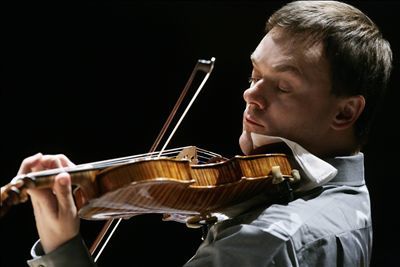
Photo by Klaus Rudulph
Young violin soloists face no small dilemma, when it comes to procuring a fine instrument. Should they borrow (or rent) the very finest instrument possible, knowing that it can be withdrawn at any moment from a sponsor, or that they might be asked to fork over millions of dollars to buy it at some undefined point in the future? Or should a soloist pass up on the chance to play an instrument like that, and instead invest their money and spirit in finding a modern violin that will live up to expectations and carry a much more reasonable price tag?
The simple answer is "get a modern, they're just as good." It's too simple of an answer, though. I've spoken to far too many experienced violinists to believe that there's nothing particularly special about the Strads and del Gesús -- to play one during the crucial beginning of one's career is to have an instrument that will inform your playing and sense of aesthetic for a lifetime. It's a special experience that just might be worth the possible pain of a bad break-up. Plus, you may wind up with a kind sponsor who just lets you use it for your entire playing career.
Or not! It gets very, very ugly, and soloists describe losing their beloved instrument like "losing an arm," one becomes so attached. Certainly, it is like losing your voice.
How would you advise the most promising young soloists today to handle the instrument dilemma?
You might also like:
- Frank Peter Zimmermann's 1711 Strad in Limbo
- How Giora Schmidt found his modern violin
- Comparing Strads and Moderns, with Phillip Setzer, Cho-Liang Lin and the Paris Experiment researchers
- Violinist.com interview with Frank Almond: the 1715 Lipinski Strad
Tweet
Posted on February 27, 2015 at 4:43 PM
play a strad, and have a copy of the instrument built.
Posted on February 27, 2015 at 6:14 PM
1) The sound we hear today from instruments made by Antonio Stradivari and his peers is very different from the sound they would have heard, because of fundamental changes to the structure of the instrument over the last two centuries, the advent of new types of strings with a different sound to gut, and even the modern bows.
2) How many decades will it be before the old violins will gradually cease to be everyday tools for the working soloist or concert master because of the increasing age of the instruments (and perhaps even a perceived deterioration in tone and playability), consequently finding their way into museums or collections? Not all that many I suggest.
3) The best luthiers today are making violins that sonically are at least the equals of the old ones, and their starting point is the old violins at their zenith. They should therefore be encouraged.
4) The exponential increase in the value of the old violins to impossible levels due their constant (and possibly quietly diminishing - see #2 above) numbers and the increasing number of truly great young players coming on the scene. No argument there, I think.
[Edit added] Since I posted the above I've seen the previous comment. It's a good and valid point, and I am sure it is being done, but for most of us "first catch your Strad" comes to mind!
Posted on February 27, 2015 at 8:52 PM
Posted on February 27, 2015 at 10:17 PM
1. A copy, however well made, will not sound like the original! It's not like copying someone's recipe for chocolate chip cookies.
2. I kind of wonder, can you really find "the one" modern instrument that could work for you as your primary instrument, if you are always practicing and playing concerts on another instrument (ie. the Strad you have on loan)?
Posted on February 27, 2015 at 11:11 PM
Posted on February 27, 2015 at 11:29 PM
I'm a great believer in cutting one's coat to fit one's cloth; buying a house, a car, a piece of professional equipment, or whatever beyond one's means is asking for trouble, tragedy, or, at the very least, stress.
One artist has to give his instrument back b/c he can't/won't buy it. Earlier, another violinist had hers removed because, if I remember correctly, she became pregnant, and the lender decided she was insufficiently committed to her career. There are enough hostages to fortune in our world without adding the possession of something you cannot truly afford. (Besides, there are some STUNNINGLY wonderful 'modern' instruments in the world.)
Posted on February 27, 2015 at 11:46 PM
I've long been interested as a player in the wide variety of differences in sound and playability of violins, and intently endeavored to train my senses to discern subtle differences as I strove to upgrade my tools through a succession of purchases.
Over the years, I've gratefully had the opportunity to have test-played on the order of perhaps 600 violins (mostly mid- to higher-level) in violin shops in the U.S. and around the world, and have had the privilege to play a half dozen Strad/delGesu/Amati instruments. Of the latter, I would never want a third of those, a third were fine, and a third were extremely gorgeous under the ear.
The couple of real standouts have remained mentally embedded tonal references for all subsequent comparisons, and I have never yet encountered a new instrument that fully matched such complete beauty. I am well aware of the much-publicized and controversial tests in which a few modern instruments have been perceived by some to be on par with a selection from leading old makers.
Based on my findings, it seems highly advantageous for promising players to use the finest instruments available, if only for a short while, be it hours, days or years. This will provide great inspiration during that period, and also will provide a valuable reference point, as they should concurrently seek out a personally affordable instrument for their own purchase, be it old or new. And the choice is definitely not just Strad or modern, there have been a couple hundred years of production by others in between!
I wholeheartedly agree with Laurie's comment that "A copy, however well made, will not sound like the original!" I've heard or read several luthiers comment that they might never live long enough to hear their products at their ultimate best. In the book The Violin-makers of the Guarneri Family by Hill, an interesting comparison of how long it took to "season the tone of the most famous makers' instruments" is presented. This ranged from 10 to 80 years for makers listed, with Strad 30-60 years and del Gesu 40-80 years.
Even if I had a fine old Strad on loan, I would definitely want to own the best instrument I could afford in order to have a ready solution for just the situation Zimmermann experienced.
Posted on February 28, 2015 at 12:16 AM
Posted on February 28, 2015 at 2:06 AM
Posted on February 28, 2015 at 3:13 AM
Cheers,
a dear fan of violinist.com :)
Posted on February 28, 2015 at 4:18 AM
Posted on February 28, 2015 at 7:21 AM
An ad on Craigslist will not necessarily get a donor to pop out of the woodwork..
And a young player may not yet not have the experience to know how to interact with a maker to get the desired result.
Anyway, who is to decide that a talented youngster deserves to be called a "soloist" ??
Being a young player at any level is hard. Sheer luck is needed. It's so hard for anyone, let alone a youngster, to navigate the sea of confusing & dubious advice that abounds.
Posted on February 28, 2015 at 3:09 PM
Posted on February 28, 2015 at 5:06 PM
Posted on February 28, 2015 at 5:25 PM
A generation or two ago you could buy an old Italian for about the price of a VW. Not exactly cheap, but a young pro with a good job could swing it. As these instruments became investment vehicles for hedge funds and Russian oligarchs it's no longer practical for individual musicians to own them. Fine instruments have been left on trains and in cabs, outside front doors, have taken falls down stairs and been backed over by cars. Does any young musician want to be known as "the kid who ruined the del Gesu"?
Posted on February 28, 2015 at 6:21 PM
As a pilot and airplane owner as well as an adult student of the violin, the parallels are apparent to me.
Flying is a passion, as is music and the violin. It is all too easy to let one's emotions hold sway and over power one's sense of logic and reason. Getting emotionally attached to someone else's possession can lead to decisions with undesirable consequences.
It is a shame that the old instruments have become out of reach of the talented players who can bring the most out of those wonderful instruments.
Perhaps instead of having these instruments on indefinite loan, they should be loaned out for definite periods of time then passed on to another player. That way the music loving public can still hear these great instruments as they were meant to be heard and hopefully, the players won't become too emotionally attached to an instrument they can never afford to own out right.
Of course, we are discussing music, which is all about emotion.
Posted on February 28, 2015 at 7:58 PM
Posted on February 28, 2015 at 10:28 PM
Indeed, I bet some soloists own a Strad (a lesser one of his instruments) but then play on the instrument of choice. Noone said you have to actually play on it.
Posted on February 28, 2015 at 11:50 PM
Posted on March 1, 2015 at 9:56 AM
Yes, and if the concert instrument we might beg, borrow, steal, or (perish the thought !) BUY, is a Stradivari then we are upper-crust-odians.
Posted on March 1, 2015 at 12:58 PM
So who decides what violin sounds better than all others? The player, the critics, the violin community at large, the audience? Well, all of the above most likely. Definitions have changed, and will probably change again. One must remember that Strads and del Gesus were at one time MODERN instruments, albeit game changers.
Today we have Zigs, Burgess', Alfs, Curtains, etc. All marvelous instrument makers to be sure. As "good" as Strads? No empirical test has really proven otherwise. To say that it can't be a magnificent instrument just because it's not 300 years old made by a dead guy from Cremona, Italy, I can only see as an absurdity. Perhaps it really just comes down to a status symbol. A badge of honor. There are only so many to go around. If you perform on one, you're part of an exclusive club that only the best players get to belong to. Maybe that's the real mystique. I'm not suggesting that these old and venerable instruments are not great fiddles. However, I am suggesting that their superiority over anything else, ever, is an artificial construction that we really must get over.
Posted on March 1, 2015 at 4:46 PM
Hilary Hahn explained her reasons for sticking with her Vuillaume very well
in Laurie's interview .
Hilde Frang also plays a Vuillaume.
How about this performance :
https://www.youtube.com/watch?v=v0xypy7JCF4
BTW the violist plays a modern.
Patricia Kopatchinskaja plays a Pressenda.
I heard her perform the Mendelssohn. Great sound.
Maybe these instruments do not have the same appeal to the general public
as a Strad or DG but in the end of the day are people staying away from
Hilary Hahn's concerts because she doesn't play a Strad?
The concert going public might be more aware today
of the fact that there are other great instruments.
Posted on March 1, 2015 at 4:52 PM
Posted on March 1, 2015 at 5:41 PM
Indeed. Dr. Cole hits the nail on the head. The question seeks to simplify a complex issue. A great many young players will need to work on a borrowed instrument far lower in cash value than a Strad. One orchestra I worked for gave me an interest-free loan for a violin. I started my career on a new violin; the maker had agreed to a payment-plan. Anything worth its salt is expensive nowadays.
Generous assistance to talented young players IS urgently needed. Very few of them are trust-find kids. Even those contemplating using a modern fiddle might have to fall back on a loaned one, as I did as a student.
Posted on March 1, 2015 at 8:22 PM
Domenico Nordio plays on Ansaldo Poggi:
https://www.youtube.com/watch?v=AF4y8sggGZY
Correct me if I am wrong but to my knowledge Josef Hassid performed on Vuillaume at this recording:
https://www.youtube.com/watch?v=ZSbU6ndKdM8
Arnold Steinhardt on this recording plays Zygmunowicz:
https://www.youtube.com/watch?v=CSY-PzXP-Kk
Svetlin Roussev on Gregg Alf:
https://www.youtube.com/watch?v=9M9Hrvr3iJQ
And then he plays on Strad together with Tedi Papavrami on his Bayon:
Helena Baillie plays on Collin Galahue's violin:
https://www.youtube.com/watch?v=7KLFYE8JCJshttps://www.youtube.com/watch?v=VulnjkMy74E
Posted on March 1, 2015 at 8:30 PM
Giora Schmidt - Hiroshi Izuka;
Christian Tetzlaff - Greiner
etc...
Posted on March 1, 2015 at 10:54 PM
Maybe not. We frequently hear about soloists who need quite a long time (like a year or more) to learn to get the best out of their Strad, but it's rare to hear of a soloist investing that kind of effort in a modern.
Posted on March 2, 2015 at 2:49 AM
The reason why some people think Strad sounds better is because they know they are listening to a multi million dollar instrument in advance, thus produces a placebo effect which makes them to believe the Strad must sound good.
Posted on March 2, 2015 at 3:53 AM
It's an interesting discussion though and I have one thing to add. These old italiens were famous for a reason, I read that craftsmen were working very hard just to get by so it wasn't the name that got them so famous. All the masters of the past would have to be complete muppets for all playing on the famous instruments once they get the money. You might say that the name draws the croud, it means something obviously but I think it's just not true.
Posted on March 2, 2015 at 4:56 PM
I understand that's less personal than the violin, because at least you can count on having another Steinway wherever you go. But with the violin, lots of things can happen that might prevent you from performing on your "main" instrument on a given evening, and then what?
Posted on March 2, 2015 at 10:21 PM
From perusing this thread, it strikes me that players with finer instruments would greatly serve the upcoming generation by letting those students known to be very careful and respectful of the tools of the trade to have a few minutes of fully-supervised trial just to help train younger ears and inform learning minds.
Anecdotally, I once had a shop owner pass me a Strad without informing me of that in advance, but this was only after I had been observed handling and playing several other finer instruments there with the utmost care and respect. I immediately noticed and commented on the superior tonal quality, and only then was I told what I was playing. The preceding trials were various 18th and 19th century works by better makers, no modern ones at that time.
And what is "modern"? By a living maker? Made in the last 25 or 50 years? From the 20th and 21st century? I guess I tend to think of it perhaps as roughly post-WWII, but even that now covers a lot of years, though a small fraction of the total years of violin manufacture. In addition to the Strad vs. modern choice, there's a very interesting and lengthy post-Strad but pre-modern time range of violins from which to choose.
Posted on March 3, 2015 at 1:33 AM
This says to me that the top 100 soloists and concertmasters in the world can seek these instruments. Everyone else should take advantage of having a living luthier build and tune an instrument to match their personal "voice". Then if the happen to fall into a really nice old instrument then great, but in the meantime they can at least have an instrument which matches them. Is this a bad line of reasoning?
Posted on March 3, 2015 at 8:11 AM
Posted on March 3, 2015 at 5:54 PM
Posted on March 4, 2015 at 6:24 PM
As to whether the piano or the violin is harder to play, that's one of those pointless debates. However, in terms of intonation, aren't we constantly regaled with tales about how this or that great player would pick up a violin that's terribly out of tune and play perfectly in tune thereupon? It must be true to at least a limited extent because a violin can hardly hold perfectly in tune over the course of a whole 25-minute concerto.
I wish I had a nickel for every time I heard that old saw about learning a violin was a Strad only after playing it and finding its tone wonderful. The same people will insist these instruments are hard to play and it takes great skill or a lot of time working with them to realize their nuance. Have you also been at a wine tasting where you were surrounded by "wine snobs," none of whom could detect the cork taint what was obvious to you? That is another true chestnut.
Posted on March 5, 2015 at 8:06 AM
Her website reveals that "She plays a 1708 Matteo Goffriller violin made available by the Stradivari Trust."
If a player needs to borrow, it doesn't have to be a Strad.
This entry has been archived and is no longer accepting comments.