
We have thousands of human-written stories, discussions, interviews and reviews from today through the past 20+ years. Find them here:


V.com weekend vote: Who has the advantage in violin-playing, right-handed or left-handed people?
Often when people learn that I am left-handed, they ask, "Do you feel that is an advantage, in playing the violin?"
Do right-handed people ever get this question?
I've also been asked, "So do you play the violin left-handed?" Which is kind of the opposite of the above question.
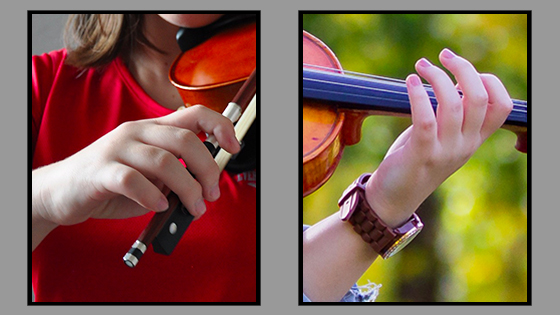
So does being left-handed confer any advantages, in violin-playing? Or does being right-handed? Which do you feel confers the most advantage?
I also wonder about the evolution of how we play the violin and which hand came to be used for what. If science tells us that the right side of the brain controls our left hands, while the left side of the brain controls the right, then is there something in the creative right side of the brain that works best for a violin hand, something in the analytical left side that works best for a bow hand and arm?
As a left-handed person, yes, I've always felt like it was a nice advantage, that my left-hand was tasked with doing all that intricate fingering business on the fingerboard. I've never been in the least bit tempted to play the violin "left-handed," holding the violin in my right hand and bowing with the left. That said, I've had to work pretty hard on my bow hand and arm!
So I'm interested in everyone's thoughts about this question. Who do you think has the "advantage," the violinist (or violist or cellist) who is right-handed, or left-handed? And what is your perspective, do you consider yourself right-handed or left-handed? What are your thoughts on handedness, as it relates to violin-playing? Please participate in the vote, and then tell us your thoughts, in the comments!
* * *
Enjoying Violinist.com? Click here to sign up for our free, bi-weekly email newsletter. And if you've already signed up, please invite your friends! Thank you.
You might also like:
- Violin Practice: Using Both Hands to Connect the Technical and the Musical
- Discussion: About Left Handed Violins...
- The All-Purpose Left Hand Exercise - Form and Flexibility For Violinists
Replies


I can't imagine how I could answer the question.
Most if not all "tools" (including musical instruments) are designed or are used in a way that is naturally easiest for right-handers. It would be bizarre if the violin would be an exception to this.
Esther, that's an interesting comparison, to use of the fork. I live in Europe now, and worked for years here. But well before I came to Europe I decided, as Europeans do that using the fork in my left hand, the non-dominant hand made way more sense. It's all what one grows up with or is used to of course.

I’m neutral on this. I’m mostly right handed. However, I use my fork and pen with my left hand, and it feels natural.
My mother sat across from me, as a small child, and took my left hand in her right hand and taught me these things. It seems perfectly logical that the fork is placed to the left of the plate.
What bothers me, is smearing ink as I write.
When I teach left handed young music students, I teach them right handed, convincing them that they have an advantage this way. Many of them prove that they actually do.
I think it’s good for the brain to have a little ambidexterity.
Not sure, I have no idea what one of the two must feel like!
I didn't vote; I really don't know the answer. If somebody wanted to find out they could get a bunch of teachers document their results with right and left-handed students and do a statistical evaluation. Depending on how detailed the reports are one might even answer sub-questions like "does right handedness result in better bowing and worse intonation?" or some other question along those lines.
I would really like to see a study on the percentage of musicians on all instruments that are left handed as compared to the percentage of lefties in the general population. I seem to know a lot more left handed musicians and wonder if the left brain/right brain dichotomy has any effect. As a violin teacher I noticed that lefties have an easier time with vibrato but a harder time with spiccato, but it all evened out.
I feel that left-handers have a slight advantage in playing the common right-handed violin because they can coordinate their left handedness with a dominant left ear and eye. Peripheral hearing and vision tend to focus more on the left side and left (fingering) hand, where more immediate and important information is being sensed, rather than the right side and right (bowing) hand.
There are different degrees of handedness of course; some folks are more left handed or right handed than others, which makes it somewhat difficult to generalize about advantages.
If the violin is for right-handers, then why does it take them so long to learn it?

I said "right-handers" but my reasoning is pretty speculative. The idea is that because most people are right-handed, and this has been true I believe back to ancient times, then the instrument evolved to be more playable by them. The same might be true of all instruments in some way..
My question was only rhetorical.
The tradition of playing "right-handed" might have begun with the lyre.
Raymond, I think you’re right, as I stated above I have “both handedness”. But I’m not ambidextrous. I think handedness is on a scale, a spectrum, and isn’t a hard and fast bi-handedness thing.
And maybe we could call it “left brained” and “right-brained”, and on a scale?
I don’t know.
And of course we must consider the piano.
There is a man who has had a left-handed piano made for himself.
More money than sense.

An important point regarding what the two hands do is that the sound isn't created until you do something with the bow. Thus you are in control of the sound with the bow hand. The intonation with the other hand does matter of course, but the actual sound doesn't happen until you move the bow.
Then with bowing techniques there are a lot of ways you can create the quality of the sound and/or the type of tone colour when you play. Thus because of the feeling of being in control of the sound a right handed person would feel that it is natural to use the right hand for bowing .
Then a left-handed student turns up wanting to play the violin. Ideally speaking you would swap the hands and use the left hand for bowing, but a main problem here is that you would need a violin built for left-handed people, because it is not sufficient to just re-string the violin, putting the strings in the opposite sequence. There are other things which need to be changed too, so it can be an expensive violin.
Therefore when I get a left-handed student I give the student a normal violin and let him/her get going on that. In most cases it actually works out fine at the end. But I did once get a student where it simply would not work that way. So I took a normal student violin and changed the strings around so it could be played left-handed. It is not the optimal violin for a left-handed person, but a student will of course not spend a lot of money on a properly built left-handed violin as a beginner.
I do know of a professional cello player who plays on a left-handed cello. He plays in an orchestra, so he is sitting with his instrument differently from the other cello players. But it is an unusual situation, I think most players would work hard in order to play on a normal instrument. There are a lot of nice instruments out there which the musician could never buy or even try out if he/she needs a left-handed instrument, so it makes sense that you would prefer playing a right-handed instrument if at all possible.
And I have a left-handed friend who plays the cello who vehemently insists instruments must be played right-handed unless your name is Jimi Hendrix.
The right is my "executive" hand. When I play it's my right hand that makes executive decisions and causes sounds to emerge, loud or quiet, when I want them to.
If it’s fingers first, before the bow, it could be just a little easier to be left handed.
But you can't make much noise just with your fingers. Once upon a time a proto-human like the homo erectus whose hand-axe I have on my bookshelf discovered a better way of gaining the attention of his troop. Instead of banging a log, of course with his dominant hand, he found he could gain their attention more effectively by causing a hollow log to vibrate.
Violin to didgeridoo is some thread drift.
What else is a violin but a hollow log?
Right vs. Left? We all are ambidextrous in that we use both hands differently, but still both hands. The issue is dominance.
I can peck out a tune with my right hand on a keyboard but my left, which dances on the fingerboard, but left hand on the keyboard (where I've had zero training) is a whole different world of inability.
So, I'm right dominant but can use the left for many daily activities.
Does it really matter in the long-run?
Is there a brain scientist on this forum?

What is the percentage of left-hand dominant string players in professional orchestras compared to the population as a whole ??
Some left-handed violinists will do rather drastic things like; switch sides, switch the strings, have the sound-post and bass-bar switched or even have custom left-hand violin made. But I have Never heard of a right-handed violinist choosing to do those changes to the left side.

I voted "neither." I'm right-handed, which puts me in the majority. I started violin as a kid and found bow arm mastery more challenging than left-hand fingering.
This article has been archived and is no longer accepting comments.








February 1, 2026 at 07:43 PM · I'm left-handed, and I feel like it's only been an advantage in my liking the violin as a child - I was always good at both sight-reading and memory (probably something to do with me ending up a scientist), so I breezed through the early pieces, which convinced me I was great. It caught up with me in an unpleasant way when my right hand failed to catch up the way the teacher thought it naturally would with time. So I suppose it's balanced it off in the end.
Regarding the reasons for the hands doing the jobs they do, my theory is that it's the same as the reasons behind conventional cutlery use. It seems illogical for the right-handed majority to hold the fork in the left hand. I always thought I had the advantage in holding the fork in the same hand as I would if I didn't have a knife. But then if you think about people sitting around the fire slicing off chunks of a shared piece of meat with their knives, and shoving them in their mouths, it makes sense for the cutting hand to be the right. Similarly, early string playing was mostly bowing, and the left hand intricacies, like the idea that you don't just grab food with your off-hand, came later.