

September 2012
An Inaugural Season: The First Rehearsal for the Boston Philharmonic Youth Orchestra
September 26, 2012 20:06There’s that moment in a rehearsal when, all of the sudden, everyone, to put it simply, gets it. These seemingly ephemeral moments stay with us for years at a time, and often are the reasons why we play classical music. These moments only come when every single person of the group is physically and mentally involved, giving everything they have for that one second of time. It is more than just playing closely to the dynamics, or playing perfectly together another section. It is about diving into one’s own introspective and truly feeling the piece. “Look up,” exclaimed Mr. Zander, “eyes on me and be aware of everyone else’s sound around you.” That’s when it happened. We were working on Beethoven’s Egmont Overture, closer to the beginning of the piece. I can recall not only looking up and seeing the difference, but also hearing it. The orchestra became one musical entity, with all the voices beautifully coming together in the masterpiece that is Beethoven’s Egmont. To think this effect is magnified in a concert setting builds the excitement even more. Many people ask, that if we sound this wonderful on the second rehearsal, how we shall sound in November after having a dozen rehearsals and sectionals, let alone the tour nearly nine months away.
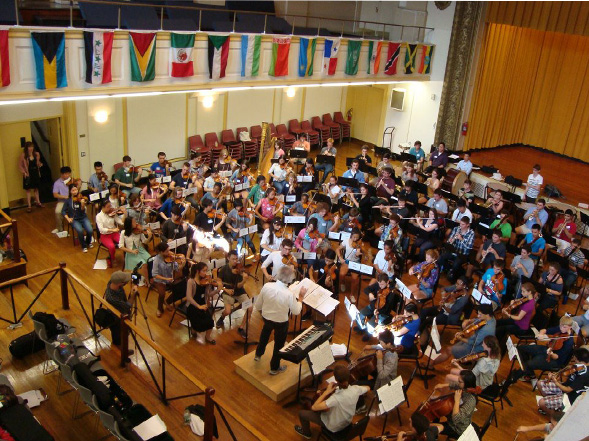
Indeed, the first few Boston Philharmonic Youth Orchestra (BPYO) rehearsals showed more than just promise for such a special ensemble of young people. Not only did the orchestra have no trouble capturing the heroic spirit of Ein Heldenleben, but many of the deemed impossible passages were plowed through like a practiced study. The lengthy excerpts did their job, as half of the famous The Hero’s Battle section was learned. At the famous return of the theme at rehearsal 77, the orchestra was so passionate that I forgot to come in after we finished the section. During all of this, many people came in off the streets through the open doors to hear Strauss’ masterpiece. I counted at least 15 extra people listening in on the inaugural rehearsal of the Boston Philharmonic Youth Orchestra. I noticed to or three of them stuck around for at least an hour until the rehearsal was finished.

The orchestra being comprised of about half college players and half high school players has a bar that is set very high. Not only are we expected to learn our notes and rhythms by each rehearsal, but we are also expected to dig so much deeper than any normal orchestra, not because of the way we play our instruments, but because we are young. As young people, we have the privilege of experiencing much of this music for the first time. I don’t believe a single person in the orchestra has ever played Ein Heldenleben before, and the sheer excitement of attempting such a piece is enough to bring a wave of passion that makes each of our concerts special. This is what makes BPYO an extraordinary youth orchestra, and in the end, this is what I believe will bring about our ultimate success. Perhaps the best part of it all was when we walked out of the hall on rehearsal break, and saw a table of food beautifully prepared for us. Food during break? Fantastic!
You can find a video of highlights from the first rehearsal here.
 1 reply
An Inaugural Season for the Boston Philharmonic Youth Orchestra: Excerpts...
September 3, 2012 14:33What began as a tragic happening mid-season for the Youth Philharmonic Orchestra, when conductor Benjamin Zander was fired, has now transformed into a new and wonderful opportunity. I remember the very conversation in the hallway when my fellow orchestra members and I asked Mr. Zander if we could have another opportunity to play under him again. Now, as the members of the Boston Philharmonic Youth Orchestra look towards the inaugural season, excitement builds every day.
I plan to write a blog entry twice a month about the inaugural season of the Boston Philharmonic Youth Orchestra with Benjamin Zander. I will detail the journey of an orchestra, as a member, preparing to perform three highly publicized and anticipated concerts, play with world class soloists, and embark on a demanding 12-day concert tour of Holland culminating in a final concert at the legendary Concertgebouw in Amsterdam.
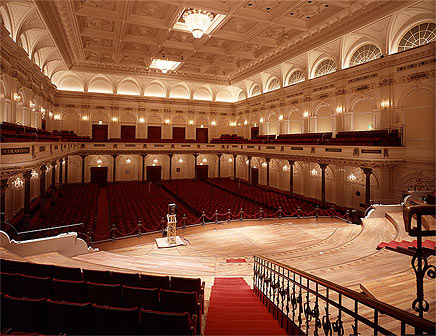
(Grote Zaal of the Concertgebouw)
Our repertoire includes Mahler, Strauss, Beethoven, Schumann, Elgar and more. Our soloists range from BPYO members, to the famed concert cellist Alisa Weilerstein, to the young wunderkind pianist George Li, winner of the 2010 Thomas and Evon Cooper Competition. In addition to writing about rehearsals and concerts, I plan to interview some members of the orchestra and, if I am lucky, some of our brilliant soloists. Most importantly however, I hope to share with you the feelings of what it means to be apart of such a journey, and some of the unspoken truths of a young person being in a demanding youth orchestra.
Before all of the mayhem can begin however, there is much work to be done. Seating excerpts were just sent out a couple weeks ago, and many members simply gazed at them, not knowing what to do. These excerpts are from Richard Strauss’ Ein Heldenleben. “He’s nuts…,” was what my teacher said when he saw the title of the piece. Ein Heldenleben, the final and perhaps the most demanding tone poem written by Strauss, is a piece that even top orchestras would shy away from. It requires depth and facility within the strings and so much more from the winds. To top it all off, you need a good concertmaster to play some of the whimsical and virtuoso violin solos. When the music was put on the stands of the Cleveland Orchestra under George Szell, the members would begin to breath heavily, wondering how they were going to pull it off (Member, 51’-65’). To give you and idea of just how hard a single part within this piece can get, take a look at the viola part around rehearsal 94-97.

This part would be hard for anyone, but keep in mind that it is incredibly difficult to shift quickly on the viola as the instrument is so big. Now, even if the viola section plays all of that together, it still has to fit in with the other parts of the score. Perhaps we will need a miracle; perhaps we won’t. All I can say is that I am glad that these parts are required excerpts, as the sooner we know our notes the better things will be.
Our first concert featuring Ein Heldenleben is November 25 in Boston's Symphony Hall. The concert will also feature the Elgar Cello Concerto with soloist Alisa Weilerstein and Venezuelan guest conductor Rafael Payare, winner of the 2012 Malko Competition. My next entry will detail our first rehearsal, but until then, I have to go practice excerpts…
More entries: May 2012


Violinist.com is made possible by...


Dimitri Musafia, Master Maker of Violin and Viola Cases

International Violin Competition of Indianapolis

Violinist.com Holiday Gift Guide


Johnson String Instrument/Carriage House Violins
Subscribe
Laurie's Books
Discover the best of Violinist.com in these collections of editor Laurie Niles' exclusive interviews.

Violinist.com Interviews Volume 1, with introduction by Hilary Hahn

Violinist.com Interviews Volume 2, with introduction by Rachel Barton Pine