
We have thousands of human-written stories, discussions, interviews and reviews from today through the past 20+ years. Find them here:


V.com weekend vote: What do you use to tune your violin?
Playing on an instrument that is highly prone to losing its pitch, we string players must tune our violins, violas, cellos and basses on a constant basis.
I'm curious about what people are using to tune their instruments these days, in terms of reference pitches and feedback.
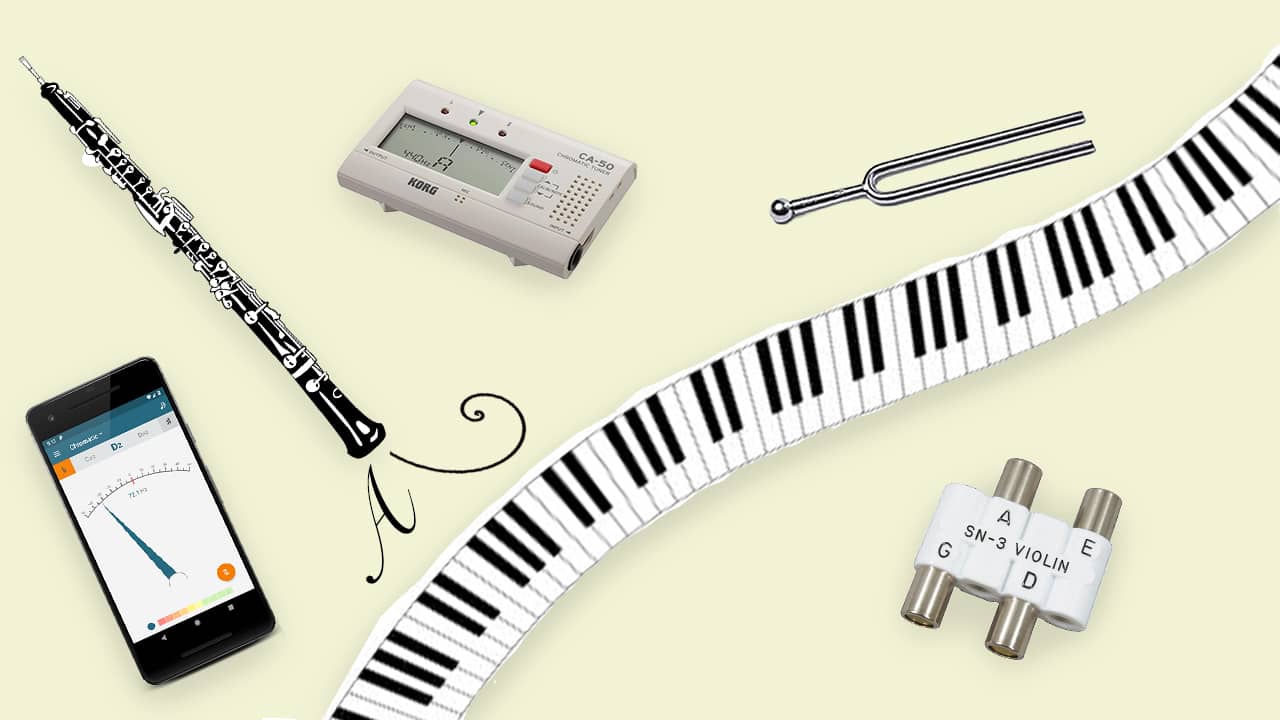
You can argue that there are two ways: by ear, or using a tuner. But all of these devices give you some kind of tuning feedback - very few people can simply pick an A 441 from their brains and use that to tune - so few that I did not include that as an option (but please do share, if you have that kind of fine-calibrated perfect pitch and can use it for tuning!)
When I first began to play violin as a child, I actually used a "pitch pipe" for reference, when I was tuning! For those who have never seen one, it's like a little bespoke harmonica, with just four pitches (EADG). Mine was small enough to fit into the little pocket in my violin case. Its one drawback was that if you blew too hard into the "E" it was flat. Nonetheless, it came in quite handy, since my family didn't yet have a piano!
Believe it or not, I remember there was one violin at my elementary school that had a pitch pipe built into the tailpiece, so you could blow on the endpin and produce an "A." I kid you not! (It was the '80s...)
Then a friend showed me a "tuning fork" - whoa! I thought this was amazing, you just bang this metal fork against something solid to set it vibrating, then touch it to the top of your violin (or a table), and it produces an "A."
When chromatic tuners came along (around the turn of the century, but before phones...) people could be quite judgmental about them. However, violinists seem to have come around to them, as they greatly help students, and they help in getting exactly tuned to 440, 441 or 442.
These days, a lot of people use apps for tuning. With my own students, I still recommend that they get a separate chromatic tuner (and metronome), so they can completely stay away from the phone during violin time. Also, for children or teens, it makes it so they don't have to rely on a parent's phone if they need to tune or use a metronome.
What device or method do you use most, for tuning? If you are me, you likely use several different methods of tuning (the oboe in orchestra, the chromatic tuner at home, the piano when playing with a pianist...), but for the sake of this vote, please choose whichever you find yourself using the most. And then please share your thoughts in the comments - has your way of tuning changed over the years? Do you trust your ear? Do you feel okay about using a chromatic tuner? If you use an app, which have you found to be the best? Do you have any of those old-fashioned devices like the tuning fork?
You might also like:
* * *
Enjoying Violinist.com? Click here to sign up for our free, bi-weekly email newsletter. And if you've already signed up, please invite your friends! Thank you.
Replies


I do not like battery powered tuners. Too many of them “hear” a different note. I use my tuning fork when I can find it. Right now I can’t. So I’m using a cellphone app. Then I tune it where it really sounds right.
Oh, and once I get A tuned on my ukulele, I tune the rest of it to itself. I teach my beginners the same way. They get real confused trying to learn those darn electronic battery powered tuners.

The list was missing what I use: ears. I only get out a tuner if someone doesn’t trust mine (because their instrument is at a slightly different pitch), but my pitch memory is very reliable.
What the question really should have been is what do we use as a tuning reference, as we pretty much all tune with pegs and fine tuners ??
When I'm practicing alone or otherwise playing by myself, I usually just approx-ball it, meaning that I know what's around A440 and tune to what I think is right in my head. It's pretty close to A440 give or take a few cents. Of course when playing with others, I do tune to the oboe in orchestra, the piano when I'm playing with a pianist in any capacity, and sometimes when I'm practicing with YouTube recordings I just listen and tune to match as closely as possible so it sounds coherent to me.
Still a dinosaur here using not the 441 you asked about. I can indeed pick a 440 out of my head, quite accurately. But I generally use a Korg anyway.
Like you, Laurie, I started with a 4 pipe tuning apparatus. Seemed accurate when I compared it years later to other tuners including pianos.
It got rather disgusting though. Since I was a young boy, hygiene and cleaning the thing was not a priority.
(Also had remnant finger nails in the side compartment of my case where I perpetually kept a nail clippers. The clippers always seemed to have a few nail bits falling out that I hadn't noticed were stuck inside. Another topic, and totally disgusting, both of these, but that's the way some of us boys were.)
I never liked tuning forks for various reasons, and was never sure I'd accurately tuned to one.
Of course, with orchestra, when I used to play with one, it was the oboe. And likewise, with piano it's the piano.
I seem to worry more about tuning than the people I play with! I start with the tuner on my tuner metronome (which I've calibrated to be the same A as my keyboard and phone tuner app, not obvious as there seem to be lots of different A's around). Then I check between in tune on the tuner, and in tune between the strings themselves. But then we get an A at orchestra, briefly, without much time to really check the other strings. I would love for you to give us an article about how to tune in this situation! Mostly it's a wing and a prayer for me.
I don't have an accurate memory for pitch but my violin usually holds its pitch well so at home I'll usually just check that it's in tune with itself. If necessary (e.g. after changing strings) I'll take A440 from a Yamaha metronome.
I’m another who uses ears, probably 90% + of the time , I’m lucky to have a great sense of pitch. However, when I need to give an orchestral tuning A I double check to an app on my phone .
If I’ve been away from an instrument for a long time ( yes, I’m with Nathan Cole for taking a vacation from my playing occasionally ) I will double check to my phone , especially if all the strings have got even just a little bit out and I’ve lost a lot of sympathetic overtones.
I'm between methods. I installed an app on my phone that measures frequencies and discovered that things such as d'Addario microtuners say they are for violins, but the GDAE they offer are ET. Ditto for any chromatic tuner. So I calculated the Pythagorean frequencies and tune to them. My intonation is fine - I just can't hear open strings' pitches. My preferred method would be an A tuning fork, as I hate the proliferation of battery devices.
I selected something else - which isn't quite true, as it is a combination of two of the options. When I am at home, I use my Korg chromatic tuner which doubles as a metronome (though I don't use the metronome part too much as it is very quiet). If I am out and forget to bring the physical tuner with me, I have a chromatic tuner app on my phone. I like using this less, as its interface is not as exact as my Korg.
I'm pretty sure my Korg TM-70T is ET, but it's hard to tell except on the G string. Logically a chromatic tuner can't be anything else. My app's violin tuner is ET. I'll assume my d'Addario microtuner is until I've tested it.

I use a 415 tuning fork and then my ears for the fifths moving away from that string. Or I use the app Tunable, which offers many temperaments (I usually use 1/6 comma meantone). On relatively uncommon days when not playing alone, I play a modern violin and just tune my strings to the pitches from their guitars.

I use a tuning app on my phone but I hate it. I prefer something that "feels" the vibration of the violin because I am often tuning at the start of an orchestra rehearsal when it's noisy. I have one that wraps around the scroll of the violin but I don't always have it with me, whereas I always have my phone. I just tune 440 or 441 depending on the orchestra with the app and then tune my other strings to fifths.
And by the way I remember the pitch pipe being in the end button of the violin, too, from the 1970s, on student instruments. And Caspari pegs!
Yes, the best thing about the Korg is the transducer clamp - it shuts out extraneous noise.

As much as I like gadgets in daily practice it's usually just my ear or tuning fork. In chamber groups it's a "who's got the good A" situation. Orchestra, Oboe or in some cases piano or organ.
I often use 432Hz tuning fork videos on YouTube.
Since pitch-pipes still score 0%, I'd like to say that I possess a nice set of chromatic ones, although I never use them. And ukes used to come with sets of four. I've used them in the past for voice-testing.

I use my ears, actually the brain. It is calibrated a little sharp so sometimes I use the 440 tuning fork to stay honest.

Tuning to piano at A440 or to a bandoneon at 443, I found I could remember both with their subtly different timbres on my viola.
My French community orchestra chooses 442.
I use fine tuners to adapt to the woodwind on the fly...
I ordered middle-C tuning forks For A415 (baroque) and A442 (Europe) in case I have to "retouch" a harpsichord. Never used them.
I've got d'Addario E and A tuning forks, but they discontinued middle C before I could acquire one. Instead, for the uke, I've got a handful of Chinese C523 that cost about $3 each, possibly less. One was out of tune, but the rest were perfect.

I use a Korg TM-60, set to 440. I’ve also had an A-440 tuning fork since my student years, but I don’t need to use it now unless the battery on the Korg gives out.
Even though I have so-called perfect pitch, I still use the tuner at the start of each practice session to be really sure. If I must, I can tolerate up to 442 - it still sounds like A to me; but I’m less comfortable with going below 440.
I find that consistent tuning each day helps my fiddles stay in tune. Most days, even in the hot, humid summers of north-central AL, USA, the A and the other strings hold their tuning from one day to the next and don’t need any adjustment from me. I don’t doubt that my using steel E and composite-core A-D-G helps.
This article has been archived and is no longer accepting comments.










January 12, 2026 at 01:58 AM · The D'Addario Micro Tuners for violin and viola are great, in particular the models that use a coin battery.