
We have thousands of human-written stories, discussions, interviews and reviews from today through the past 20+ years. Find them here:


The Violinist's Guide to Protecting from Coronavirus and Other Germs
Playing the violin can be a very communal activity, and with the instrument right up against our faces, we have some unique considerations when it comes to being sanitary during the outbreak of any disease, whether it's the coronavirus, the flu or the common cold.
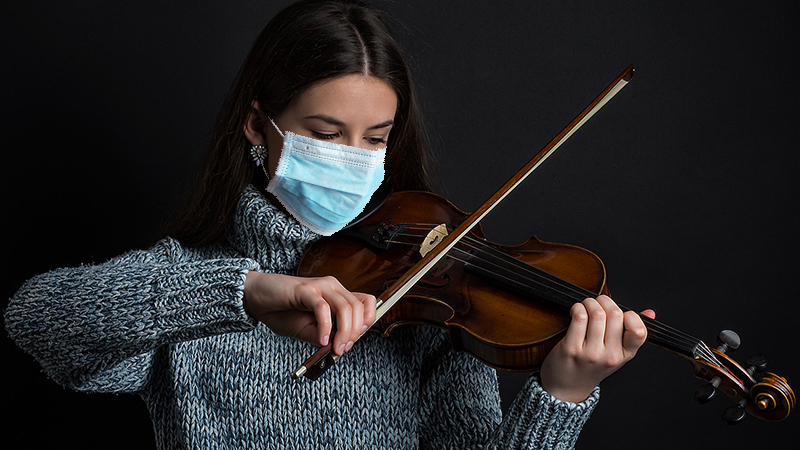
This might be going overboard, but you get the idea....
Here are a few ideas to consider in regards to your violin or viola and your activities during this current environment of potential virus transmission. Please include your own suggestions in the comments!
- Don't go to rehearsal, to your lesson, to school, to the party, to the store, to anywhere... if you are sick.
- Wash your hands before and after playing. That means, wash them before and after rehearsals (and during breaks); before and after your violin lesson; for teachers, before and after each student. You need to wash your hands for a long time: sing "Happy Birthday" twice through, and that should be the right amount of time. Or maybe the opening of the Mendelssohn Concerto - just make it something that lasts at least 20 seconds long!
- Use alcohol wipes to wipe your chinrest. This might be impractical, but I'll make the suggestion anyway: teachers can wipe the chinrest of each student's violin before tuning it. It's also safe to clean the fingerboard and strings with alcohol wipes. I recommend the small alcohol wipes that one finds in first aid kits -- you can buy these by the box a drug store. They work best because they won't drip onto your violin. (Luthiers, is it okay to wipe the pegs with alcohol wipes?) Don't get alcohol on the varnish of the violin itself. You can use those wipes on your phone, too.
- If you have to tune someone else's violin, use hand sanitizer before and after, and if possible, do not actually put the violin up to your chin. (Certainly don't sneeze or cough on the fiddle!) You can tune a violin (especially a small one) with it down on your lap; see picture below:

Listen by bowing the string with violin on your lap. You can also use fine tuners while bowing with violin on lap. Turn pegs with violin upright. - Doctors say that people need to be one meter away from one another - that's about two arm-lengths - to be safe. Keep this in mind when getting situated for a lesson, a rehearsal, a quartet practice, a group class, etc.
- When it comes to masks: Doctors are saying that the mask will not protect you from getting the virus, but it can do two important things: First, it will protect other people from getting a virus from you, if you happen to be infected. And second, it will serve as a reminder to you, not to touch your face, as if you try to scratch your nose, it will be under a mask! That said, when masks are scarce, they should be reserved for medical workers.
- In case all the hand sanitizer is all sold out at your local store, our own longtime Violinist.com member Yixi Zhang gives us this simple recipe for home-made hand sanitizer, which she got from a pathologist: mix two parts 99 percent alcohol with one part aloe vera gel.
Again, please share your tips and ideas in the comments below, and stay healthy!
You might also like:
- Coronavirus Partially Locks Down Violin-Making City of Cremona
- Discussion: Practicing while sick
- How to practice, in six steps
Replies

The piano in the room I teach at school is my biggest concern and gets a thorough wipe down at the start of each working day.
Remember, you can use alcohol to sanitize a violin IF you make sure to never wipe the main body, just the strings, chinrest, pegs, and tailpiece. Alcohol will destroy varnish, but it's safe on most metal strings and denser wood like ebony fittings.


Especially those of us who play in community orchestras -- which are often populated with older folks -- need to be mindful of their intrinsic (i.e., statistical) fragility when it comes to influenza and other viruses including covid19.
Since a lot of the "contact" that we're talking about deals with tuning someone else's violin, perhaps this is a good opportunity, for kids to learn to tune their own violins. There are videos on how to do it all over YouTube, and probably at Shar as well. For kids who are too tiny, their parents should be learning anyway. My daughter's cello teacher puts an electronic tuner in a separate room so that all students (or parents) can tune their own cellos before coming into the studio proper. For that matter, when a student is playing Suzuki Book 1 on a 1/8-size violin, is it all that critical that the instrument be perfectly tuned? I guarantee it won't be when the student is practicing at home.
I can’t ask a child to play perfectly in tune if the instrument is not in tune...including beginning students on fractional-sized instruments. There are apps to facilitate this for younger students and parents (i.e.TE Tuner)
Everyone entering the studio must wash their hands. Paper towels are used for drying. I wipe down surfaces between students (15 seconds for door handles, sink and toilet handles).
I give FaceTime lessons if anyone in the family is ill.
I use wet wipes only on the necks, pegs, fingerboards and frogs (parts of the instruments that are unvarnished). I only use alcohol on the strings.
Irene Mitchell
Irene, I see what you're saying. But unless your student/parent is as good at tuning their instrument as you are, then the only time the instrument will be "in tune" according to your standards is during their lesson.
One thing you probably shouldn't share with your students/parents at all are pencils.
Paul, you tune the child's violin every week, and it often does stay in tune for quite a while after. Yes, it's better if a parent can also tune the violin, best if the student can tune his or her own violin. But when they are beginners, they are just that, both student and parent. They don't always get it in tune, even if they try, and so you tune it every week to help them learn. It's actually most critical at this stage, when they are learning what "in tune" is!
I had a rehearsal this morning. I gave elbow bumps instead of customary handshakes etc. and I hope it helped to spread this temporary custom.
Thank you for the Mendelssohn suggestion: 'Happy Birthday' gets on my nerves at the best of times!

New way of greeting:
And we didn’t know this for the last several decades as responsible teachers and artists traveling all over the globe?
Perhaps we've known this for a long time, but it seems prudent to be thinking about it, brushing up and sharing tips right now!
I've seen kids show up at violin class (I'm the accompanist) with strings that are a half-step flat. So, especially with fractional instruments, and knowing how small children "take care" of them, no, I don't agree that their instruments stay in tune for quite a while. I doubt more than a day.
For oboists and clarinetists: poke hole in mask to accommodate reed/mouthpiece. For flute players: wear mask around headjoint.
This article has been archived and is no longer accepting comments.









March 7, 2020 at 01:55 AM · Thanks for the very helpful tips, Laurie.
I'd like to add:
1.) If you need to go to a grocery store, bring a sanitizer with you to wipe the handle of your cart with, and avoid touching your face while pushing that cart
2.) If you need to put some gas on your car, wear disposable gloves
3.) It will probably be prudent not to let anyone borrow your violin then put it on your own chin soon after (at least for now, even if you wipe it).
4.) If you need to travel, it will probably be a prudent idea to postpone or cancel for now, specially if it involves flying, or being with large crowd of people.
The really concerning part is that carriers of COVID-19 may not necessarily show any symptoms of the virus. And there are some reports of communal transmission of the disease. Common sense precautions should always be taken.