
We have thousands of human-written stories, discussions, interviews and reviews from today through the past 20+ years. Find them here:


Review: Violinist Isabelle Faust Performs Schumann with LACO
On Saturday German violinist Isabelle Faust made a rare Southern California appearance, performing Robert Schumann's Violin Concerto in D minor with the Los Angeles Chamber Orchestra (LACO) and guest conductor Dinis Sousa at the Colburn School's Zipper Hall. It was the first time I'd seen her perform live, and wow, did she deliver - as did LACO and Sousa.
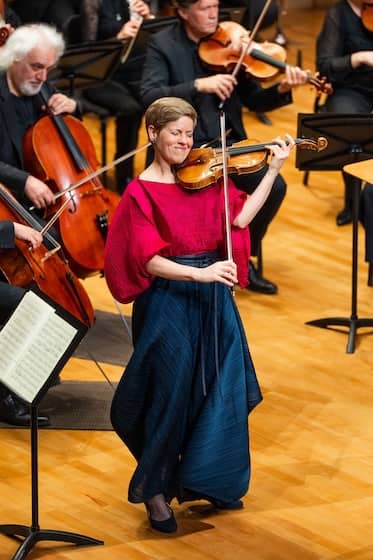
Violinist Isabelle Faust performs with the Los Angeles Chamber Orchestra. Photo by Elizabeth Asher.
Here is a violinist with a beautiful sense of phrasing and expression, backed up with a reliable technique seemingly capable of delivering just about anything the moment requires: a gorgeous melody, a blistering fast passage, double-stop trills, perfect-pitch octaves - even a vulnerable little spiral of a chord at the end of her solo encore.
She played Schumann's seldom played (and historically maligned) violin concerto with commitment and conviction. In our interview with Isabelle, she called this concerto an "anti-concerto," and after Saturday's performance, I could see why. There is no cadenza for the soloist, anywhere in the piece. The intensity of the orchestra in the first movement doesn't waver - even to make way for the soloist. Schumann gives the violinist a lot of odd gestures, and Faust leaned into that, adding color and even at times using non-vibrato to great effect.
I had the feeling that this concerto does not "play itself." For example, the melody of the second movement feels almost set against the orchestra. The last movement requires taking a simple theme laced with a thicket of notes and crafting it into meaningful music - something she did with joyous energy.
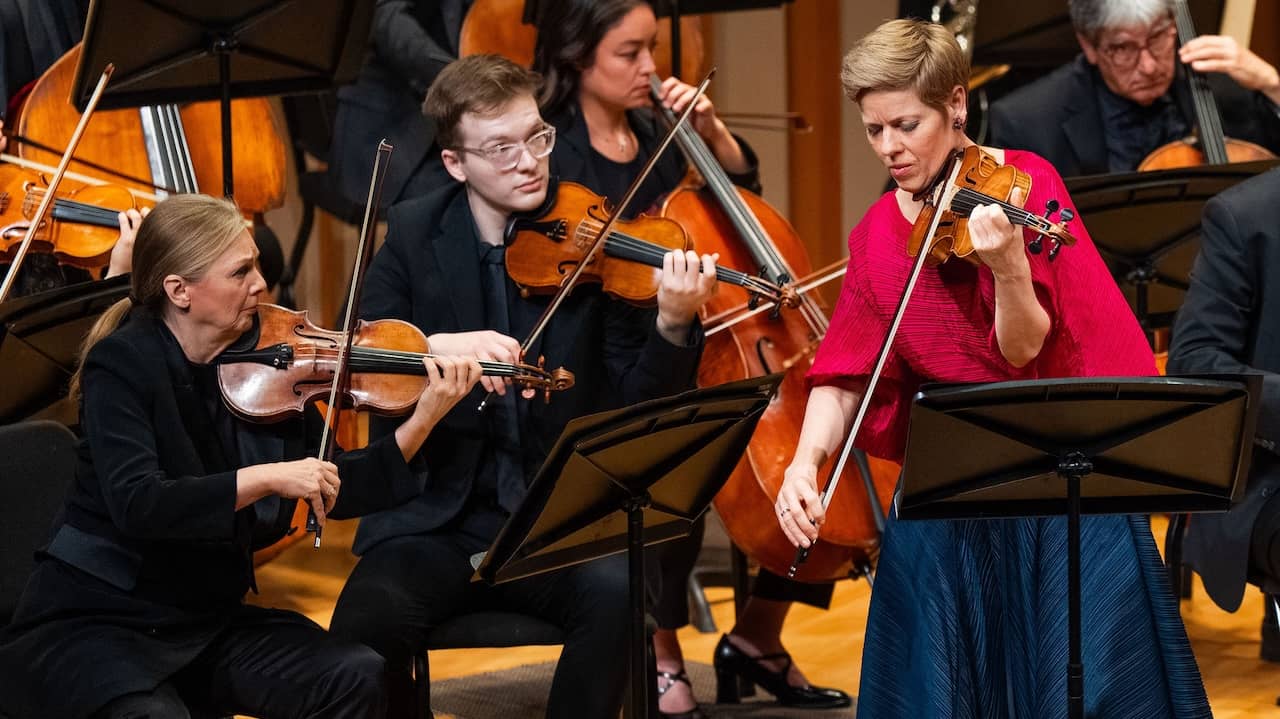
Violinist Isabelle Faust interacts with LACO Concertmaster Margaret Batjer and Assistant Misha Vayman. Photo by Elizabeth Asher.
Orchestra and soloist were enthusiastically dialed in with each other, sensitive to the details and making it work together.
But despite this exceptional performance, I did have some issues with the architecture of this concerto. Most bewildering was the second movement, which is widely considered to be this concerto's the best asset - its emotional center of gravity. While it presents gorgeous material (that melody, in Faust's hands!), it all lies in a strange rhythmic bed.
This feeling of misalignment led me to chase down the score - could that really be what Schumann wrote? And yes, it was. They played it exactly as written, to a heroic degree of accuracy. Here is a little excerpt from the score, at the beginning of the second movement (click here or on the score below and you can see a PDF of the entire first page).
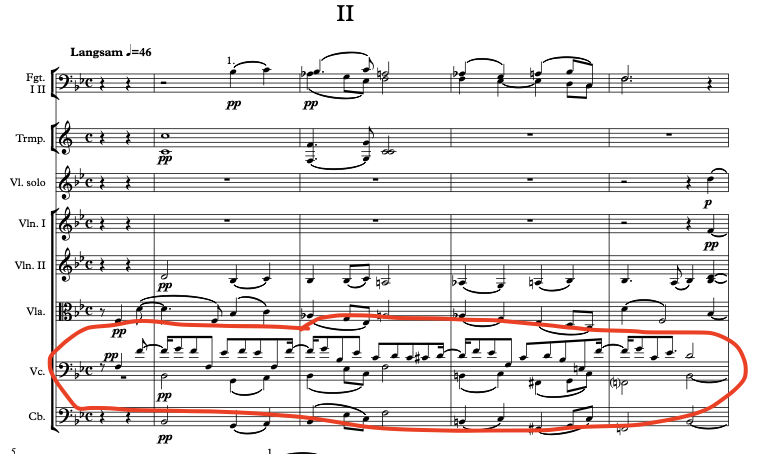
The problem: The entire movement starts on an eighth-note off-beat, as if to throw off the listener from the beginning. Fair enough. Long strings of these eighth-note off-beats return throughout the movement, both in the orchestra and solo part. But there are no on beats of the same value to set the record straight, only a slow-moving melody.
Offbeats with no "on beats" feel just - well, off. And then layer a melody over that, and the music simply feels misaligned. Perhaps it's a stroke of artistry, a purposeful disorientation. But for the listener (especially a first-time listener) how can you be disoriented when you are never "oriented"?
When one gets to know this piece well and can feel those off-beats as "right," I'm sure it takes on more meaning. Or maybe, the idea is to present beautiful melody and put it in a land of distress with none of the usual guideposts. Sometimes life is like that - it probably was for Schumann, in the days he wrote this, right before his institutionalization.
All that bewilderment did serve to make the rhythmic certitude and general optimism of the third movement feel like a real relief.
As an encore (after a standing ovation and three curtain calls), Faust captivated the audience with a solo Baroque piece, "Passaggio rotto" by Nicola Matteis (1650-1714). She played it with elegance and virtuosity, arpeggiated chords, trills, open E's and gestures - all ending with her bow undulating softly over the last chord.
The concert opened with the LA premiere of "Tipping Point" by Huang Ruo (b. 1976), an apt musical depiction of humanity's march toward climate disaster. After an introduction with soundbites from the (in)famous 2014 speech in which a U.S. Senator presented a snowball on the Senate floor to express his disdain for climate science, a woodblock starts the clock. An orchestral soundscape grows around the ticking woodblock, at times sounding like the chirping of birds, at times sounding like a runaway train. For a while the birds seem to take over, the woodblock relents and the music grows shimmery. Then it turns back to the incessant drumbeat, growing in sonic activity, featuring quite a few interesting percussion instruments: a waterphone (spiky metal implement that is bowed), Indonesian Button Gongs, a "wind-machine with thunder-tub"...
The piece ends in a disturbing breakdown - the consistent beat starts to trip and falter, pitches clash, sounds collide, then everything falls to near silence, just radio static. Quite effective, and happily the composer was in the hall to accept the applause.
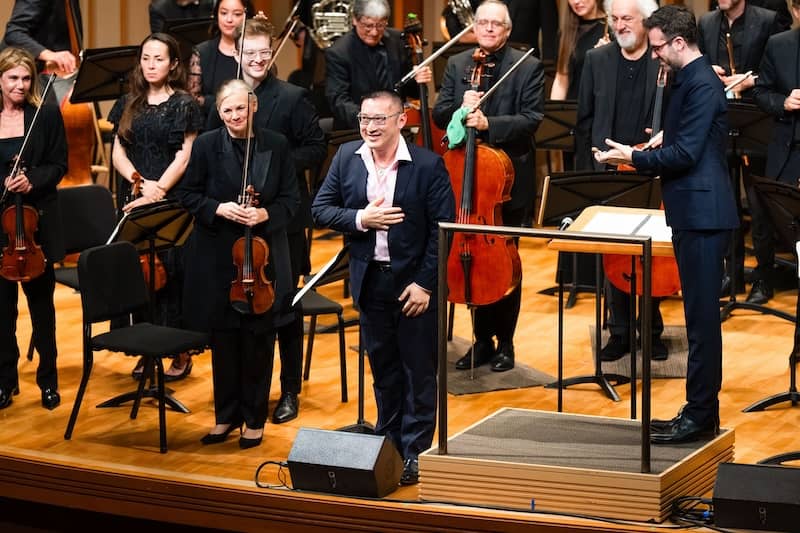
Composer Huang Ruo, following LACO's performance of his piece, "Tipping Point." Photo by Elizabeth Asher.
The evening ended with a performance of Felix Mendelssohn's Symphony No. 4 - the "Italian" symphony. As conductor Sousa had said from the podium, this piece, unlike the Schumann, was an instant success, its popularity still going strong nearly two centuries after it was written. He also mentioned that Mendelssohn kept revising the symphony, but his revisions aren't usually played, as they don't really improve the original work. Nonetheless, to mix things up a bit, this evening they would insert just a bit of Mendelssohn's "revised" version of the third-movement minuet, playing it on the repeat.
As LACO started the symphony, playing Mendelssohn's exuberant opening melody, I thought about the running triplets underneath it. Human beings can only play these so fast - don't these triplets provide a kind of natural speed limit for this piece? Not so, with these humans. LACO broke all the speed limits - this was Mendelssohn at the F1 racetrack - and a thrilling ride. It was a treat to see this group of fine musicians unleash so much energy and to witness the high-velocity precision in places like the intricate fugal section.
I enjoyed hearing the third-movement "revisions" - the music had largely the same flow, with notes in some passages inverted or slightly extended. A bit fussy, and not an improvement, to my ears - but then, my ears have grown very accustomed to the "normal" version!
The fourth movement was so fast - I began to question whether this version was depicting something thrilling or the kind of over-stimulated delirium that leads to a rehab facility. Either way, I was impressed with LACO's ability to pull it off, and it certainly kept me awake. The concert ended at 9:35 - the fastest symphony in the West!
You might also like:
- Interview with Isabelle Faust: Schumann's Otherworldly Violin Concerto
- Interview with Augustin Hadelich: A Lifetime with the Mendelssohn Violin Concerto
- Review: LACO Sets the Standard with Impressive '25-26 Season Debut
* * *
Enjoying Violinist.com? Click here to sign up for our free, bi-weekly email newsletter. And if you've already signed up, please invite your friends! Thank you.
Replies
You must be registered and logged in to submit a comment.









March 18, 2026 at 07:35 PM · Fascinating review - glad you were able to attend!