We have thousands of human-written stories, discussions, interviews and reviews from today through the past 20+ years. Find them here:


Interview with Isabelle Faust: Schumann's Otherworldly Violin Concerto
I've been a fan of violinist Isabelle Faust for a long time.
She is one of the finest violinists out there, with a career that has spanned some 40 years. She quietly has built a strong solo career and impressive discography that includes some 50+ recordings of absolutely stunning quality, often with her longtime chamber partner, pianist Alexander Melnikov.
If you hear her 2010 recording of the Bartok solo sonata, she seems to be an expert in contemporary music. If you hear her 2021 recording of Mozart Sonatas with classical period instruments, you might assume she is a Mozart specialist. Same for her recordings of Locatelli, Bach, Beethoven, Brahms, Stravinsky, Schoenberg...the list is long. I fell completely in love with her playing listening to her 2008 recording of the Fauré sonata (the second movement especially) - a fabulous performance by a great pair of artists. I was mesmerized from the start.
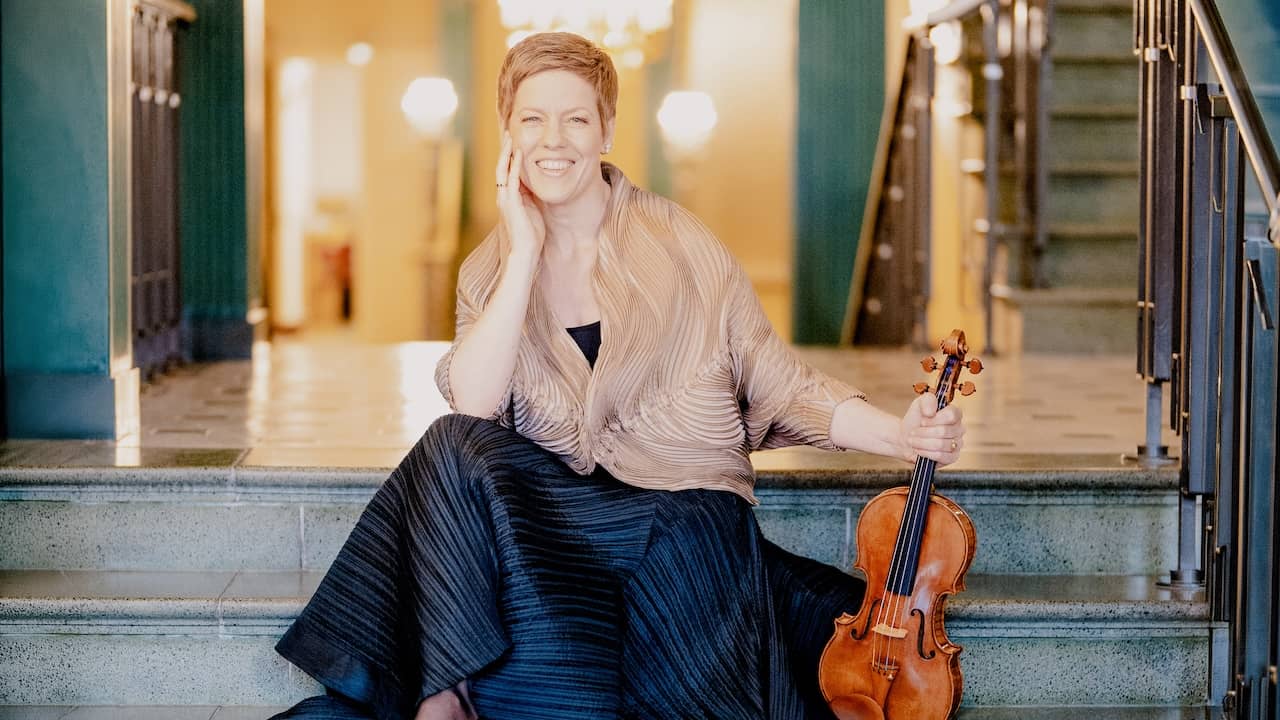
Violinist Isabelle Faust. Photo by Marco Borggreve.
I long have wanted to hear Isabelle Faust in live performance, and at last I will get the chance when she comes to the United States this month for two pairs of concerts on opposite sides of the country: first performing the Robert Schumann Violin Concerto with the Los Angeles Chamber Orchestra and Dinis Sousa (March 12 and 14, more info here), then Béla Bartók's Violin Concerto No. 2 with the Atlanta Symphony Orchestra and Kevin John Edusei (March 19 and 21, more information here).
In anticipation of her visit here, I enjoyed a wide-ranging interview with Isabelle via Zoom. We talked about her youth as the daughter of two enthusiastic amateurs, her very early experience in a serious childhood string quartet, going from second violinist to concert soloist, and her thoughts on Robert Schumann's lost-and-found violin concerto, one of the troubled composer's final pieces.
So let's start at the beginning. Born in Esslingen near Stuttgart, Germany, Isabelle Faust grew up in a house filled with music. Her mother was a high school music teacher who played the piano, so as a toddler Faust noodled around on the piano in the house.
Perhaps more consequential, though, was her father, who was inspired by his musical wife to learn the violin - an activity he took up with gusto at age 31.
"He started the violin as a pure amateur, and also switched to the viola later on," Faust said. In turn, her mother took up the cello, also as an adult beginner.
"They would go to the amateur orchestra every week in our town, and they would play string quartets - with my father's violin teacher on the first violin music stand - almost every week," she said. "There was a lot of music in our house."
At age five, Faust was asked if she wanted to play an instrument. At first they thought of the piano, "but there was no teacher," she said. "My mother didn't want to do it - wisely!"
"So then suddenly it was the violin," Faust said. "I went with my father to his violin teacher, and he started teaching me." She started learning with a modified Suzuki approach, playing by rote with no music-reading for a few years. Thus her learning was closely linked with her father's, in the beginning.
"I needed somebody to play for me, so I could imitate, and that was actually my father, who was not a great violinist!" she said. "Then, of course, at some point, he could no longer follow. But it was a little bit his dream I was living."
Her brother, two years older, also started the violin, and that gave her parents an idea. When Isabelle was 11 and her brother was 13, her parents found two other kids their age to form a string quartet with them.
"That was so successful," she said. "We took it so seriously that we won several competitions, and we started playing little concerts." Bit by bit, her father's dream began to grow into her own.
"I started to see how nice it was, to play a concert for a public," Isabelle said. She started to think: if performing public concerts could be part of her future, perhaps she would like to pursue a career in music.
Faust's young quartet participated in master classes with several well-known quartets, including the LaSalle Quartet and the Melos Quartet.
"The Melos Quartet was based in Stuttgart, so we also sometimes had lessons during the year with them," Faust said. Every year the LaSalle Quartet came to Basel, where the young quartet could participate in their master classes.
"For five years we did that, and it was very intense," Faust said. "I was the second violinist, and my brother switched to the viola for the quartet." Her brother, Boris Faust, still plays viola.
Working the La Salle Quartet, which specialized in the Second Viennese School, she had an early introduction to the music of Webern, Bartok and Berg. "It was interesting at that age, to get in touch with this music and immediately embrace it and not find it strange, complicated or too intellectual," she said.
But then as teenagers, the quartet parted ways.
"From that moment onwards, I never again had a stable string quartet, which I find a great pity," she said.
By that time she was 15 years old. "I suddenly came out of that second violin life, and I didn't know how to judge my own playing, in comparison to other young violinists," she said. "I had to do all those things I didn't do while playing so intensely in the string quartet; I had to learn the big violin concerti."
Faust studied with Dénes Zsigmondy and Christoph Popppen. She decided the best way to measure herself against her other fellow young violinists was by entering a competition. The feedback was quite encouraging: she won First Prize in the Leopold Mozart Competition in 1987 as its youngest entrant, then First Prize in the Paganini Competition in 1993.
Nonetheless, chamber music is a thread that has continued to run throughout her life.
"Later on, when I started playing as a soloist with orchestras, I still played a lot of chamber music, but in chamber music festivals," she said. The violist Bruno Giuranna invited her to festivals in Lyon, France. And she met violinist Joseph Silverstein at a festival in Sarasota, Fla. "Joseph Silverstein was a great inspiration for me, too," she said. "So I did continue to play a lot of chamber music, and on the first violin, which was quite different from the second violin!"
For her concert with the Los Angeles Chamber Orchestra, Faust will be playing Robert Schumann's Violin Concerto in D minor, a piece with a fraught history. Written in 1853, the piece was never played publicly until 1937, well after the composer's death. Why?
"The piece has an incredible story, actually very sad," Faust said. It was one of the last pieces Schumann wrote before his suicide attempt and subsequent admission to a psychiatric hospital in Endenich. Joseph Joachim, the violinist for whom this was written, along with Schumann's wife Clara and the young Johannes Brahms - "they decided that those last late works were not for the public," Faust said. In fact, it was decided that the violin concerto should not be brought to light until 100 years after the composer's death.
In the 1930s the American-born British violinist Yehudi Menuhin learned of the violin concerto by Schumann and decided that the world needed to hear it.
Sadly, at the time the Nazi regime deemed that no, a Jewish violinist could not premiere this concerto. "They were hoping to kick out the Mendelssohn Violin Concerto by putting the Schumann in its place," Faust said, Felix Mendelssohn being a composer whose Jewish roots disqualified him from greatness, according to the Nazis' Aryan ideals. "It is a very bad, ugly story."
"So they made the violinist Georg Kulenkampff premiere the piece," she said. They arranged to make the Schumann concerto more like the Mendelssohn concerto: "More champagne!" Faust said, "they sent it to (Paul) Hindemith. which was very curious, because Hindemith was absolutely not a Nazi favorite, he was already in Switzerland by at that time. But he was asked to arrange the Schumann concerto in a more virtuoso and sparkling way." For example, Hindemith put about half of the piece an octave higher.
"So this is the way how it was premiered," Faust said, "and of course, it was not a success, because the whole DNA of this piece is absolutely not about sparkling virtuosity; it's a very interior and very thoughtful piece. They were trying to make something out of this piece that was completely against the nature of what Schumann wanted to say."
Yehudi Menuhin still did his premiere in New York one month later. "They couldn't prevent him from doing that, and he stuck to the manuscript, he did the original version, which was wonderful," Faust said. "(Menuhin) always defended this piece, but the piece was not appreciated back then, and it was forgotten again. It's only the last 10 years or so, that the Schumann concerto has come back again. There are quite a lot of recordings now, and a lot of my colleagues have learned the piece and love it. Still, it is not often programmed."
"In a way, it is an anti-concerto," Faust said. While the Mendelssohn concerto is outgoing, throwing the music straight at the audience, the Schumann concerto is more introspective, drawing the audience inward. It's more of an exploration of the soul, she said.
"The second movement is out of this world," Faust said. "It begins with violoncello soli, with half of the section playing in syncopations against the rest of the orchestra. It gives this feeling that something not on safe ground. It's also like a dream - everything is in pianissimo, not completely real, as if in a fog. There is a theme he uses several times."
That theme is significant - at the end of his life, while in the hospital, Schumann wrote the "Ghost Variations," a piece for piano solo. "It's exactly the same theme as in the second movement of the violin concerto," but in his delusional state he didn't remember that. He thought that Schubert had come to him in a dream and dictated the theme. "But it's a very particular theme, I can understand why this theme became his obsession."
"Is a beautiful movement, absolutely," Faust said. "And then the first movement is very impressive, there are a lot of Baroque associations. The first bars are in octaves, going downwards - it reminds me a little bit of Don Giovanni, it has this very dark feeling. It has triplets underneath, like the pulse of your heart, but they don't let you go. It's a little threatening - dark and uncompromising. Then there is a second theme which really warms your heart."
"The last movement is a very slow polonaise," she said. "I think this has been misunderstood for a long time." Performers have tried to make it into a virtuoso movement by playing it very fast, "but he actually wrote metronome markings, and they make sense if you understand that it's a slow polonaise, a very proud movement - dancing, and full of dignity."
"It's a really unique violin concerto," Faust said. "I don't know any other violin concerto that could be compared with it. And I still meet orchestras that have never played this piece before!"
When she performs the piece next week with LACO, the conductor will be Dinis Sousa, "and I know he loves the piece," Faust said. While she has not performed with him before, Sousa was an assistant to conductor Sir John Eliot Gardiner, and "when I played the Schumann Concerto with Sir John Eliot a few years ago, Dinis Sousa was assisting, playing the orchestra part on the piano so I could work with Sir John Eliot before the first rehearsal. So in a sense he did do the Schumann violin concerto, with me - in a different function!"
When Faust goes to Atlanta, she will be playing a very different concerto: Bartók's Violin Concerto No. 2
"The Bartok second concerto is also one of my favorites," Faust said. "I've been immersed in Bartok since I was 11, when I met the wonderful Hungarian violinist Dénes Zsigmondy. With this violinist, I started to learn Bartok's Sonata for Solo Violin, which is absolutely one of the most difficult pieces for violin solo," she said, laughing, "at the age of 11!" Since that early experience, her affinity for the music of Bartók has continued to run deep.
The second concerto "is one of my favorite pieces, and it's also still not played enough, though it is played more often than the Schumann Concerto," she said. Playing Bartók 2 recently in Dusseldorf, she learned that the orchestra had not played it since 1988 - "I was scandalized!" she said, laughing. "This piece has to be heard, so I'm very happy be playing it in Atlanta."
* * *
- For more information about Isabelle Faust's performances of the Schumann Violin Concerto with the Los Angeles Chamber Orchestra March 12 and 14, click here)
- For more information about her performances of Bartók's Violin Concerto No. 2 with the Atlanta Symphony Orchestra March 19 and 21, click here.
You might also like:
- Violinist.com interview with Rachel Barton Pine: Schumann Violin Concerto
- Interview with Violinist Christian Tetzlaff: the Loving Hand of Brahms
- Interview with Augustin Hadelich: A Lifetime with the Mendelssohn Violin Concerto
* * *
Enjoying Violinist.com? Click here to sign up for our free, bi-weekly email newsletter. And if you've already signed up, please invite your friends! Thank you.
Replies
You must be registered and logged in to submit a comment.