We have thousands of human-written stories, discussions, interviews and reviews from today through the past 20+ years. Find them here:


Gateways' Alex Laing at ASTA/SAA 2026: Inviting a Better Future Through Practice
How do you get to the future? Practice, practice, practice!
This is an idea that Alex Laing explored in his opening keynote address to the thousands of teachers, students and string industry professionals gathered for the 2026 joint conference of the American String Teachers Association and the Suzuki Association of the Americas last week at the Hilton San Francisco Union Square.
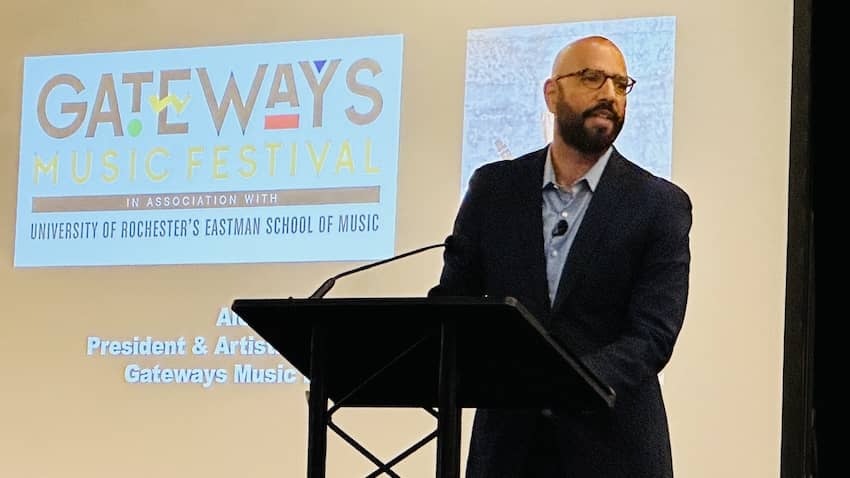
Gateways Music Festival President and Artistic Director Alex Laing gives the keynote address at the opening of the 2026 ASTA/SAA Conference in San Francisco.
After 22 years as Principal Clarinet of the Phoenix Symphony, Laing has served since 2024 as President and Artistic Director of Gateways Music Festival. Gateways, founded in 1993, connects and supports professional classical musicians of African descent through festivals, residencies, ensembles, broadcasts, and education initiatives.
When Laing was about 11 years old, his clarinet teacher did something that changed his life. He took his mother aside and told her "that I had something special, that if I worked, maybe I could do this professionally."
"He believed something about me that I hadn't yet earned," Laing said. And it changed his life.
And isn't that what practice is, after all? If you boil it down, practice the ability to see a future that isn't here yet, but that is possible. And when you can see that future, then you can work toward it.
Laing practiced. He pursued music and he found success as a classical musician. But as he negotiated his studies and then later became a part of the symphony orchestra world, he began to feel a tug in his heart, a question rising in him: "Where are all the Black people?"
He loved classical music. He loved his Black community. Why wasn't there more overlap?
He wondered if the absence of Black people in classical music was a feature, not a bug. But he clung to the notion that "there has to be a version of this art form that encompasses everything I want to be."
At age 28, he had his first experience with Gateways Music Festival, and it opened his eyes even further to this possibility. The late conductor Michael Morgan called Gateways "a family reunion with instruments." Laing described it as "the intersection of Black people, Black culture and classical music."
"Gateways showed me there was an even deeper love in me for this music," he said. "It was like I'd been living in a room that I thought was the whole house - but then I found so many more rooms."
Was there a way to move toward our seemingly intransigent classical music institutions toward encompassing more?
"We've built these engines, these institutions for vibrating air, what do we do with them?" Laing said.
Laing pointed to a recent book, called Games: Agency As Art, by C. Thi Nguyen, that describes games as an art form that help us shape our ways of forming goals and seeing our world - our striving, trying, failing, succeeding.
And in many ways, our art of music is such a game.
"The game sculpts the player," Laing said. "The rules are invisible because you are looking through them, not at them."
And certainly in music, there are rules and rewards. Music is a long apprenticeship in agency and person-building, under constraint, he said.
As a teacher, "you are shaping, for a young person, what it is to try," he said. You are working with goals - such as learning the next piece, playing the next concert. But you are also working with the bigger idea of "purpose": growing, striving, handling encounters with difficulty.
In this game, "correctness" can be a tool for awareness and self-improvement, but also - unfortunately - it can become moralized. If correctness is used for fear or compliance, then a wrong note starts to feel like a personal failing.
"What would thrive or come back to life in your teaching, if there scoreboard was removed?" he asked the teachers in the room.
He also quoted from the 2014 Art & Energy by Barry Lord, which posits that a society's dominant energy resource (be it fire, coal, oil & gas, renewables) is the primary mover of our culture and art. For example, a society run by fire is a "culture of the hearth," one dominated by coal is a "culture of work," and one dominated by oil & gas is a "culture of consumption."
"'I am' can only be completed inside of a culture," Laing said, and as we transition to renewable energy, perhaps we will be in a "culture of stewardship."
Gateways Music Festival taught him perhaps the most important thing, which is that "the path to artistry runs through community."
This took on a personal dimension when Laing was performing the Mozart Clarinet Concerto as a soloist with the Phoenix Symphony. In advance of the performance, he decided that "looking out into the hall and seeing a lot of Black faces would make it better."
So he activated his community - he invited friends, students, groups, friends of friends. He found ways to make special tickets available.
And he realized that it wasn't because the Black community needed Mozart, it was because "I need ed YOU in my Mozart," he said. When he succeeded in bringing his community to that performance, it felt like Mozart and the Black community belonged to each other.
Perhaps it is possible to imagine a different way of organizing our musical institutions.
What is the future of the orchestra? This is the topic of a book of essays that Laing helped to edit, Sound Systems: The Future of the Orchestra, which came out last summer. The essays imagine what the orchestra could be.
One essay imagined meeting with space aliens from other worlds, only to discover that "the common tongue of the universe is vibrational" - that is, our universal tongue is music.
"There are higher purposes for vibrational air than what we have been practicing for," Laing said. "If we can see the game, we can practice for a different one. Practice - it's how you invite the future you want."
* * *
At the close of this first keynote for the ASTA/SAA Conference, Christian Howes, the extraordinary jazz violinist who had just received ASTA's Artist Teacher Award for 2026, performed with several young musicians and educators. This simple act of two people playing their quiet acoustic instruments together, young and older, student and mentor, was very moving. It had the giant conference room full of hundreds of teachers from all over the Americas rap with attention and - at least me - tearing up a little!
First Christian's own beautiful piece "Postlude" with violinist Ava Pakiam, 15, in an arrangement they created and improvised together. (Chris offers a PDF of the sheet music for this for free on his website, find it here.
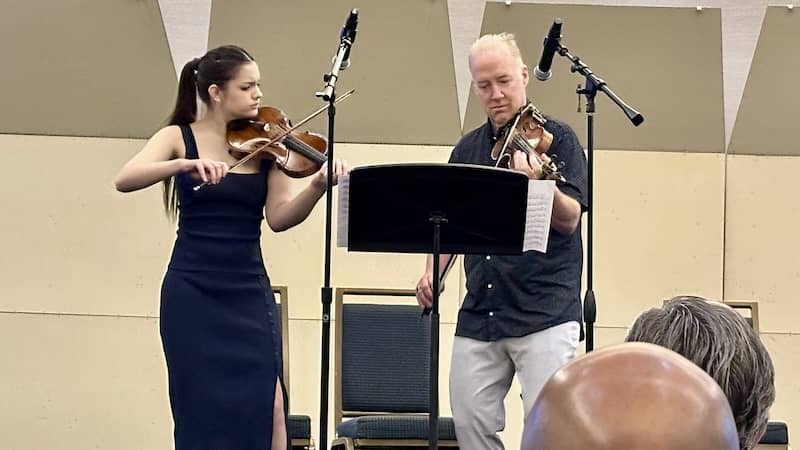
Violinists Ava Pakiam and Christian Howes performing at the ASTA/SAA Conference.
Then Howes played "Valse Hot" by Sonny Rollins with cellist Chris Tate - who plucked some wonderful sprawling improvisations that were really captivating.
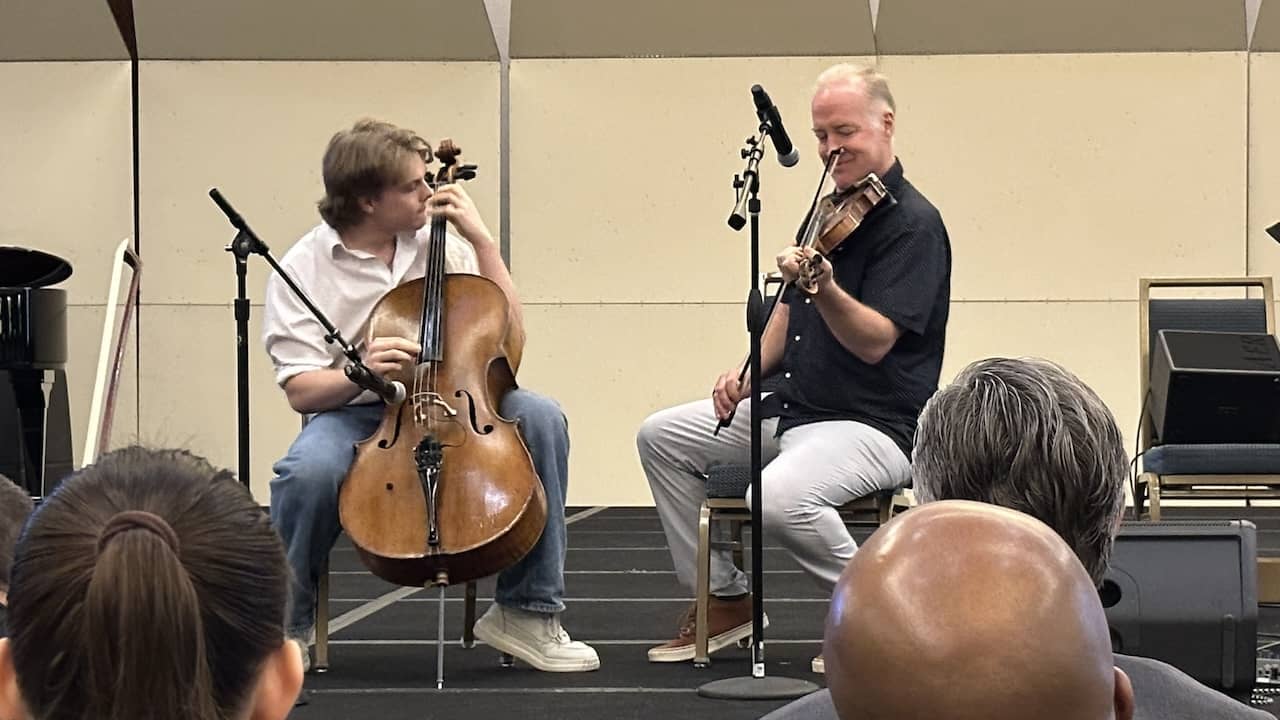
Jazz cellist Chris Tate performing with jazz violinist Christian Howes.
Then Howes used the loop pedal to create a continually expanding backup for vocalist, violinist and educator Solange Maughn of Scottsville, Va. to sing a version of "Prototype" by OutKast, ending with the audience singing back, "Thank you..."
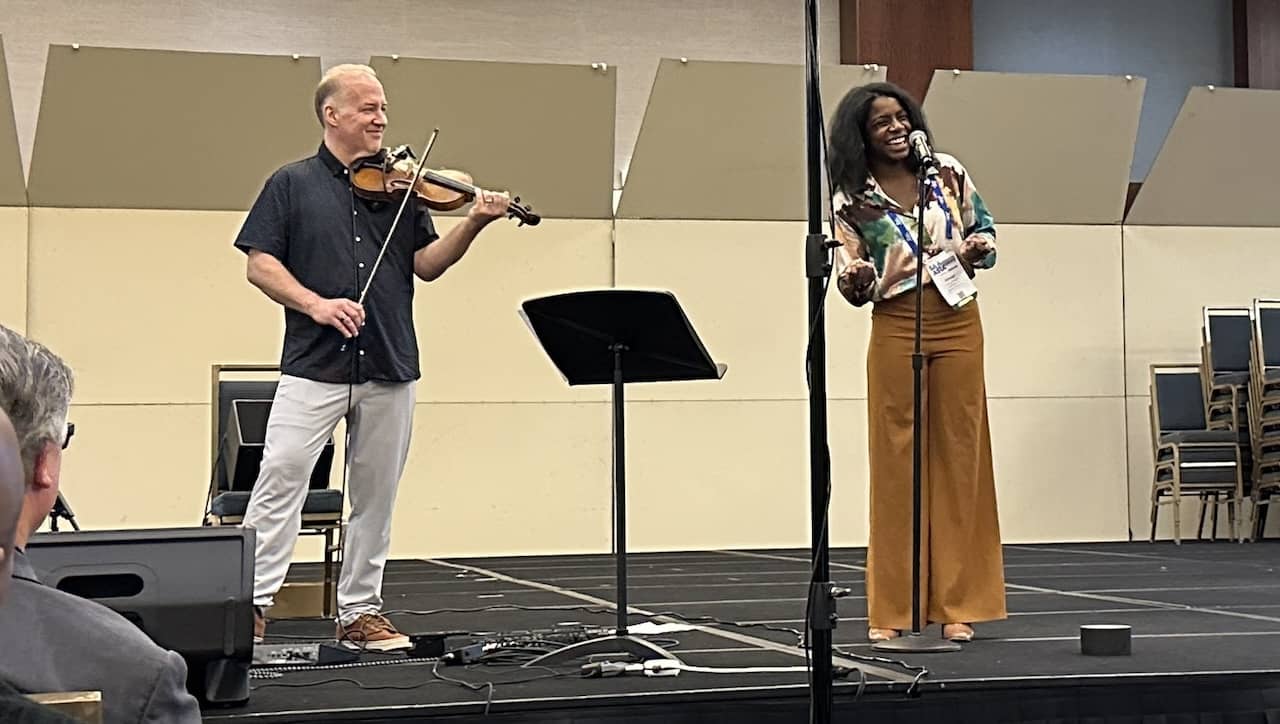
Violinist Christian Howes performing with multi-talented musician and educator Solange Maughn.
You might also like:
- Vijay Gupta at ASTA/SAA 2024: Music as a Place of Possibility
- ASTA 2023 - Inclusion and the Story of Violinist Adrian Anantawan
- Stories from Past and Present ASTA & SAA Conferences
* * *
Enjoying Violinist.com? Click here to sign up for our free, bi-weekly email newsletter. And if you've already signed up, please invite your friends! Thank you.
Replies
You must be registered and logged in to submit a comment.