
We have thousands of human-written stories, discussions, interviews and reviews from today through the past 20+ years. Find them here:


When the Newspaper Fires the Last Music Critic
The last week has brought tremendous loss for arts in America - the potential loss of a home for the performing arts, the loss of voices for the arts - and a terrible realization that these things can happen in an instant.
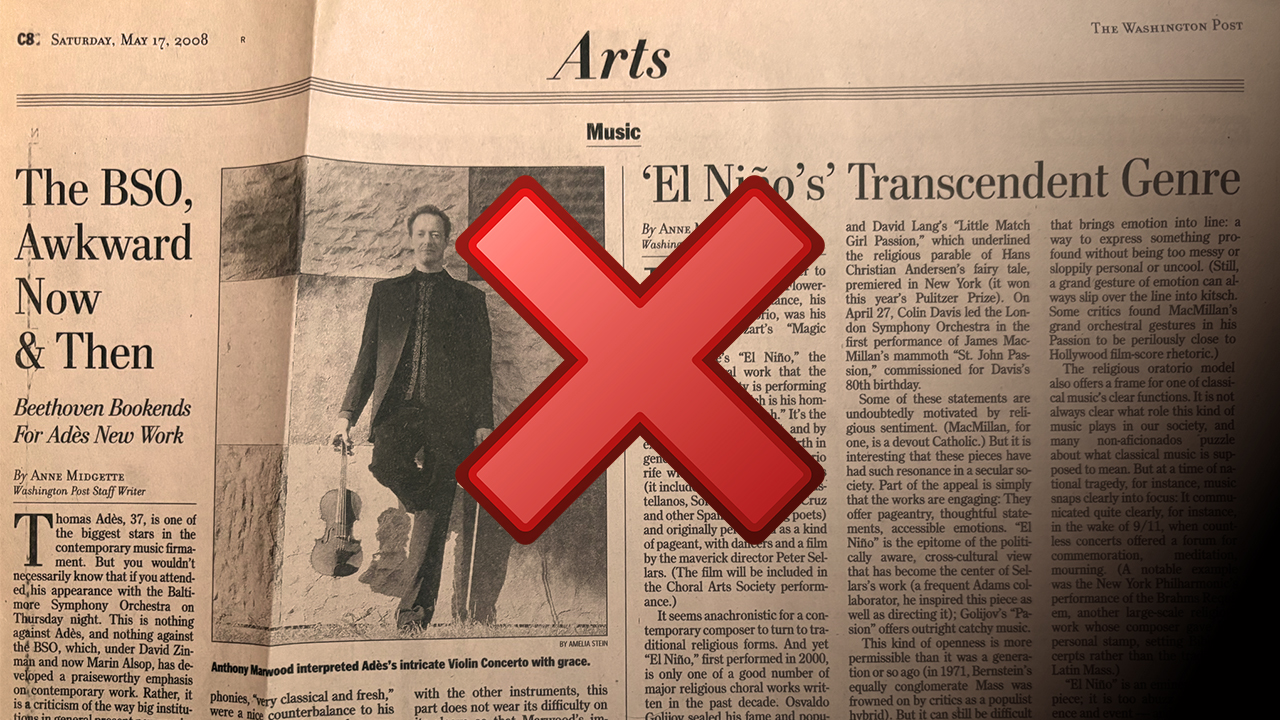
Illustration by Violinist.com; image by Anne Midgette, used with permission.
Last Sunday came the news that the Kennedy Center may be shut down for two years, displacing the National Symphony Orchestra and raising a great many concerns. Time will tell if the Kennedy Center and its resident orchestra will bounce back from the boycotts, the plummeting ticket sales and now the potential years-long shuttering and demolition of the facility. No tangible plans have been presented for its restoration; only for its imminent dismantling.
Then there is the matter of the collective voices dismissed, when the Washington Post cut a third of its entire workforce and laid off some 300 journalists on Wednesday. I have a feeling this is a true and significant death knell for the traditional newspaper.
But importantly for those of us in classical music: this is a significant stage in the erosion of coverage for arts and music.
While the loss of the Post's sports desk received the most coverage, the destruction to their arts coverage was near-complete: the dismissal of the arts and entertainment editor, visual art editor, film editor, senior style section editor, and two art reporters, as well as all the pop, classical, TV, and theater critics, according to Hyperallergic.
Let me reiterate: no classical music critics on staff at all. That kind of reliable coverage is gone from the Washington Post - and from many, if not most, newspapers across America.
Arts journalist Anne Midgette lent some perspective in a Facebook post on Wednesday: "When I started as a stringer (aka freelance reviewer) at the New York Times 25 years ago, there was a staff classical music editor, three staff critics, and another regular stringer as well as an editorial aide — all for classical music alone," she wrote. Midgette was the chief classical music critic of the Washington Post for 12 years before leaving in 2019 to focus on a book. "We already knew arts coverage was declining, but I always assumed that the New York Times and the Washington Post, at least, would continue to have classical music critics. As of today, neither does. (Joshua Barone, a culture editor at the Times, and several freelancers are writing the reviews.)"
It is clear, after this week, that the institutions that once supported our musical traditions - homes to our symphonies, repositories of dialogue about the arts - are fragile. They can be blown over by the winds of change and the whims of politics, and it can happen in a day.
Of course, those voices aren't silenced; they can go elsewhere. This publication, Violinist.com, which I started in 1996 and is based in Los Angeles, certainly supports voices that speak for classical music with our mix of blogs, reviews, discussion, listings and more. And there are niche sites across the Internet that continue to do so: The Violin Channel, based in New York; The Classical Review sites that host reviews in seven major U.S. metro areas; San Francisco Classical Voice on the West Coast; EarRelevant for the American South; and internationally, the is BachTrack. And I know I'm leaving out many more.
But when I started Violinist.com, after working for years as a newspaper reporter, I never dreamed that newspapers would abandon the arts. Because newspapers did something important: they put local symphonies and arts organizations into the context of their live-and-in-person geographic communities.
We still need arts journalism, and we need it on the local level. Maybe we can do this globally on the Internet, but we also still need local reviews, interviews and community arts news.
It is important that we recognize that our art does not exist in any real way, unless people pay attention to it. For people to pay attention to something, they need knowledge, context, excitement - even affirmation. Marketing can do this, to a degree. But reviews, interviews, stories - this kind of journalism provides the context and knowledge that can excite the imagination in our audiences and supporters. It fosters conversation that can continue over time.
If we are wise, we will recognize that the conversations around our classical music events are as important as the events themselves, when it comes to building an enthusiastic community for classical music. We still need arts coverage, arts journalism. We need to support and train those who would lead those conversations, to bring quality arts journalism back into the mix when it has been cut. When done well, writing about music is an art in itself.
When that conversation is robust, that's when we build support for raising the quality of our local arts, for hiring the musicians, for having a special space to enjoy the arts and the community they create. That's when support grows for the institutions that house our symphonies and arts.
We will need to rebuild, and we will need imagination to figure out where our arts conversations can flourish. Because without our arts infrastructure, there will be a whole lot of silence.
* * *
Enjoying Violinist.com? Click here to sign up for our free, bi-weekly email newsletter. And if you've already signed up, please invite your friends! Thank you.
Replies
The LA Times does still have Mark Swed! He’s been the music critic since 1996.


As you said above, Laurie, it's not just music (and sports) but a third of their news staff! Mr. Bezos' wealth last year increased by more than it would have cost him to GROW the WaPo for the rest of his life. The billionaire is not a worthy steward of the national institution the Washington Post, whose journalism is so badly needed in these times of worsening government lawlessness and grift. The loss extends also to international coverage: WaPo shut down its Kyiv bureau and laid off Kyiv reporters Lizzie Johnson and Siobhán O’Grady. Right while President Trump, whose brownshirts made a seditious insurrection in Jan 2021 attempting to prevent the constitutional transfer of power by blocking Congressional certification of the election that Trump knew he lost...is now wrecking NATO and every bit of respect and friendship the USA had earned worldwide...a terrible time for one of our few national newspapers to be undermined by the same billionaire owner whose "purchase" of the Melania documentary for his streaming business was priced so high as to be nothing less than a bribe to the President. Coverage of classical music will be just a small part of what is being destroyed here.

The arts are just another small casualty of the pluto-techno-mediocracy our democracy has become. It's over a year since I boycotted Amazon and I'm eagerly awaiting the consequences.
This article has been archived and is no longer accepting comments.










February 6, 2026 at 09:23 PM · Laurie, didn't you tell me once that the LA Times has not had a classical music critic in a while? Excellent post, by the way! I know there are many of us that care about and rely upon violinist.com. Please don't go away!