
We have thousands of human-written stories, discussions, interviews and reviews from today through the past 20+ years. Find them here:


Interview: Ray Ushikubo on Playing the 1741 'Playfair' del Gesù violin
Violinist Ray Ushikubo has come a long way from the $20 violin he started on at age six. In November he received the loan of one of the most rare instruments in the world - the 1741 "Playfair" Guarneri "del Gesù" violin, from the New York-based dealer Colin Maki Inc.
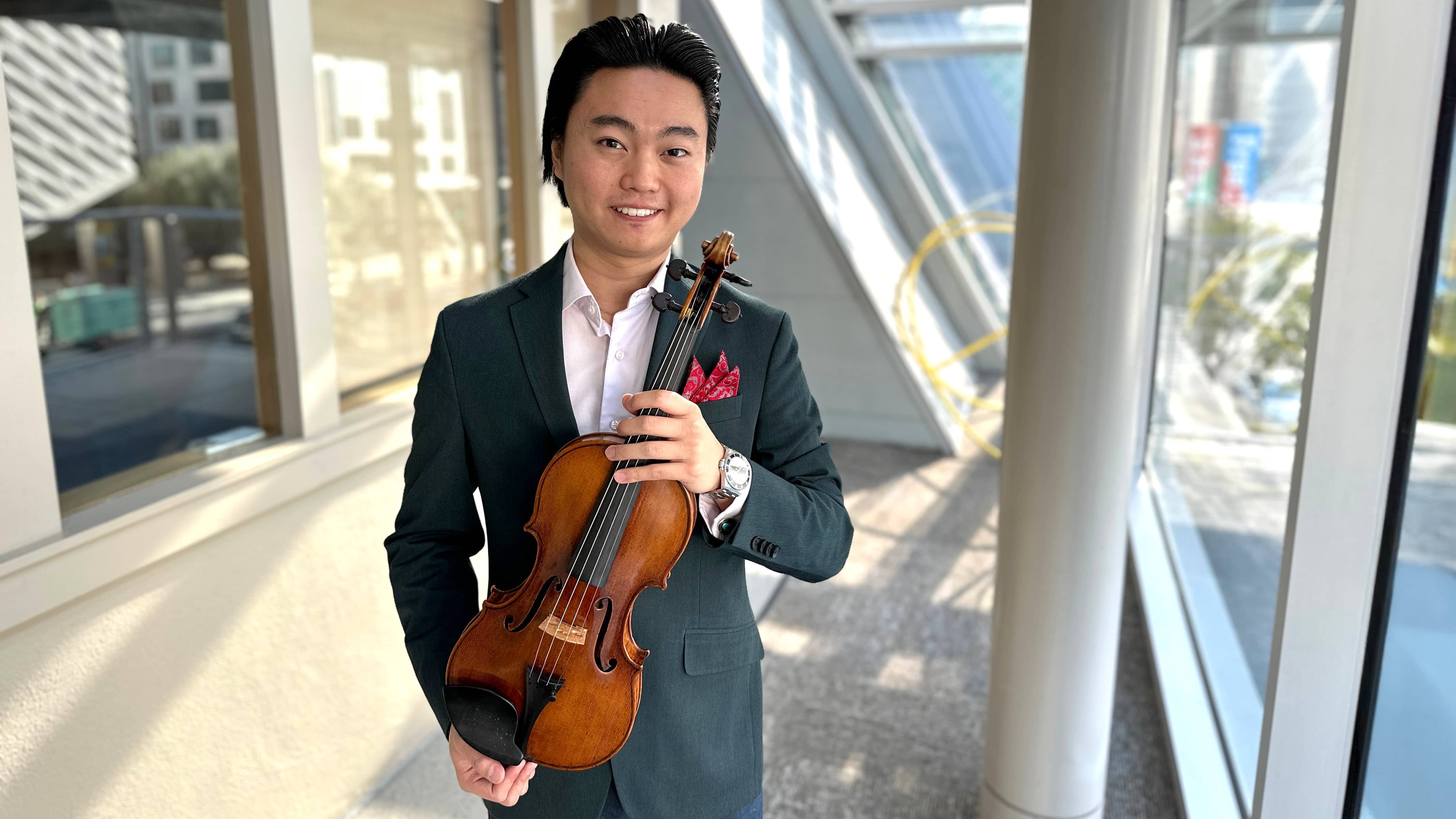
Violinist-Pianist Ray Ushikubo, with the 1741 "Playfair" Guarneri "del Gesù" violin. Photo by Violinist.com.
A native of the Los Angeles suburb of San Gabriel, Ushikubo, 24, is currently a post-graduate student at the Colburn School and under management by the school as a Colburn Artist. He is actually a multi-instrumentalist - he is also a pianist who was named a Steinway Artist as a teenager and won the 2017 Hilton Head International Piano Competition. He appeared on From the Top and the Jay Leno Show, and he has performed as a pianist with the Los Angeles Philharmonic and at Carnegie Hall.
While many people know the name of the legendary violin maker Stradivari (1644-1737), his contemporary Bartolomeo Giuseppe Guarneri (1698-1744) made violins of equal caliber. (His violins acquired the name "del Gesù" ("of Jesus") because the labels inside his instruments made after 1731 include a cross, with the Greek abbreviation for Jesus (IHS) beneath.)
"Del Gesù" violins tend to be valued higher than Stradivari violin because they are rarer - there are some 150 "del Gesù" violins left in the world, while there are about 500 Strads. While the specific value of the "Playfair" has not been disclosed, "it’s well into the eight figures," Colin Maki told the LA Times.
In other words, it's a pretty big deal, to get to play one.
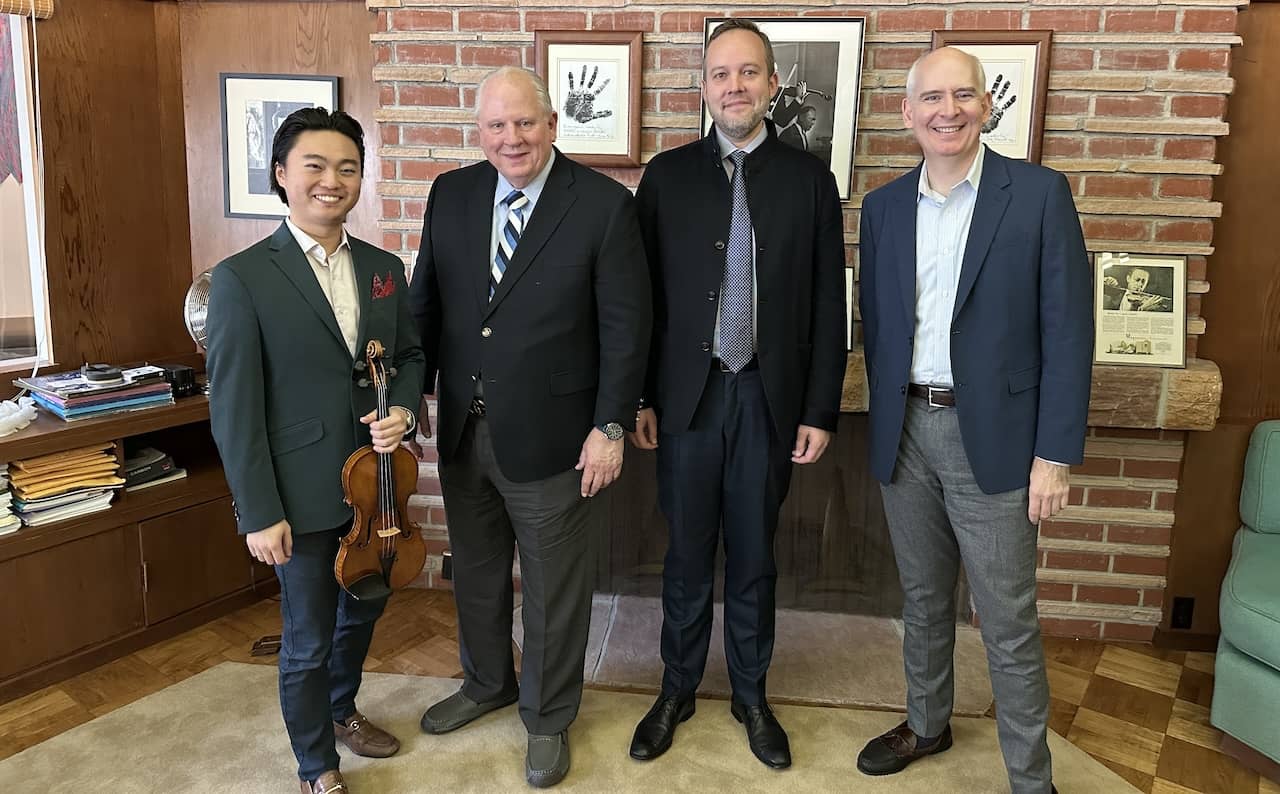
Violinist Ray Ushikubo, Colburn Violin Professor Robert Lipsett, violin dealer Colin Maki, Colburn President and CEO Sel Kardan
Over the last month Ushikubo has given a debut recital with the violin at the Colburn School and has appeared in media all over the world to publicize the loan - from the LA Times to CNN. On Sunday he will perform his east coast debut on the "Playfair" violin at a private concert at Colin Maki Inc.'s New York location.
Listen while you read: Here is Ushikubo's debut concert Dec. 3 with the "Playfair" del Gesù violin at the Colburn School's Zipper Hall. He performed the Vitali Chaconne, Milstein's Paganiniana, the Chausson Poème and Ravel's Tzigane with pianist Hsin-I Huang.
I spoke to Ushikubo the day before his Colburn recital, and he told me about what inspired someone from a non-musical family to take up both the piano and violin and pursue both instruments at such an intense level, and about his journey that brought him into this rarefied world of fine instruments.
It all started when he was five, and the family was watching a Japanese T.V. series called Nodame Cantabile, based on a manga series of the same name. One of the main characters is an aspiring conductor who plays both piano and violin.
"I thought, I want to be just like him!" Ray said. "We already had a piano at our house, but nobody played on it - it was just a piece of furniture. In fact, they were going to sell it."
Ushikubo wouldn't let them - he told them he wanted to play piano, and so he started with piano lessons.
"A few months later, I said, I want a violin!" Ushikubo said. They countered that they didn't have a violin. But Ushikubo continued to insist.
"So for my sixth birthday, they got me a $20 violin," Ushikbubo said. "It was a quarter-sized violin they found online."
At the time, he was playing piano and violin for fun; his true aspiration was to be a professional golfer.
"I wanted to be the next Tiger Woods, and so I was practicing golf for three, four hours every day," he said. "My dad was looking for competitions for young golfers, and he couldn't find any in that area."
However, he did find competitions for young pianists. So his dad entered him in the competition, and he won.
"I was about six. That was the first time I played in front of an audience, and I felt so connected with the music and the audience," Ushikubo said. "I just remember I was thinking, 'Wow, I this is the most beautiful I've played,' and it just happened to be in front of the audience. The crowd loved it."
"I think that is when I knew that music would be for the rest of my life," he said. "It was the best feeling ever."
So with all this success on the piano, why did he want to play the violin?
"I wanted to be like that character that I saw on T.V. - he played both," Ushikubo said. "So I started violin."
The $20 violin.
"When I got that first violin, they also bought this beginner's book, and it had a little DVD at the end where an instructor was demonstrating how to play the violin. So that's how I began," Ushikubo said. "They got two violins, a $20 violin quarter-size for me, and a full-size violin for my mom to play with me. My mom quit after a day, because she got sore. Then my dad started playing with me. He played with me for almost a year."
It didn't take long before they realized he needed more than a DVD, so after a few months they went to a local teacher.
Ushikubo was eight when they set their sights on the Colburn School in downtown Los Angeles. By then they had moved to Riverside, which is some 55 miles away from downtown.
"So my parents drove me an hour and a half to Colburn, three times a week," Ushikubo said - an hour and a half each way - in good traffic.
"I first started with piano lessons, with Ory Shihor. He was a fantastic teacher," Ushikubo said.
Then they heard about Colburn's star violin teacher Robert Lipsett, who has taught a host of successful violinists, including Leila Josefowicz, Robert Chen, Steven Copes, Jennifer Frautschi, Blake Pouliot, William Hagen and more.
"I played for him, and luckily for me, he said he'd like to teach me," Ushikubo said. So from the age of eight through 17 he studied at Colburn with Lipsett, then he went to the Curtis Institute for four years, where he earned his bachelor's degree, studying with Aaron Rosand, Shmuel Ashkenazi and Pamela Frank.
And yes, he continued to study piano at Curtis - with Gary Graffman and Robert McDonald. Currently he has returned to Colburn, where he completed his Master's degree and now is earning his Artist's diploma, studying violin again with Lipsett and piano with Fabio Bidini.
It's hard to imagine a more stellar line-up - for either instrument. How did he manage to continue to study both instruments, at such a high level?
"Time management is really important, obviously," Ushikubo said. Also, "I've played both instruments since the age of six - this is the only thing I've known. So it doesn't necessarily feel like it's twice as hard."
In fact, the two disciplines overlap and inform one another.
Since the piano has him playing not just melody but harmony, chords, counterpoint, etc. - this affects the way he thinks about the violin, which by its nature is often assigned just one line. "As a violinist, I think a lot more about the harmonies and internal rhythm," he said. "I think about harmony and rhythm and orchestral quality much more."
On the other side of the coin, being a violinist means that he plays on an instrument that has a highly vocal quality, and that affects his approach to the piano. "The piano is naturally a more difficult instrument to make 'sing,' to sound vocal," he said. "I'm a terrible singer! So if I'm playing something on a piano that's very vocal, I play it on violin - I copy that."
"I think playing both instruments has made me a better musician than I would have been with just one instrument," he said.
When it comes to the instrument itself, it's been an interesting journey, from the $20 Internet violin to the rare and highly valuable 1741 "Playfair" Guarneri "del Gesù," valued somewhere in the multi-millions of dollars.
Has he played Stradivari or del Gesùs violins in the past?
"I've tried them out many, many times. I've performed on them several times, but I've never kept one, it's never lived with me," Uchikubo said. "The longest I might have had was a month of playing on a Strad - and performing on it and then returning it. I had those kinds of experiences several times. So I knew what a great instrument could do, and I was always looking for a long-term partner of that caliber. Now it's happened - I feel so fortunate.
Guarneri "del Gesù" violins are infamously hard to play - they make certain demands of the player. What is it like to play this particular fine violin?
"People say there are generally two types of violin players: Strad players, and del Gesù, players. I think I've always been a del Gesù player," Ushikubo said. "You dig in more. There is a lot of physical power required. I don't mean actual muscle strength, but it does require quite a lot of effort and strength to dig into a del Gesù. Without this amount of power, del Gesùs don't allow you to sing as much. And the great thing about a del Gesù is that you can give it so much power and it can take it.
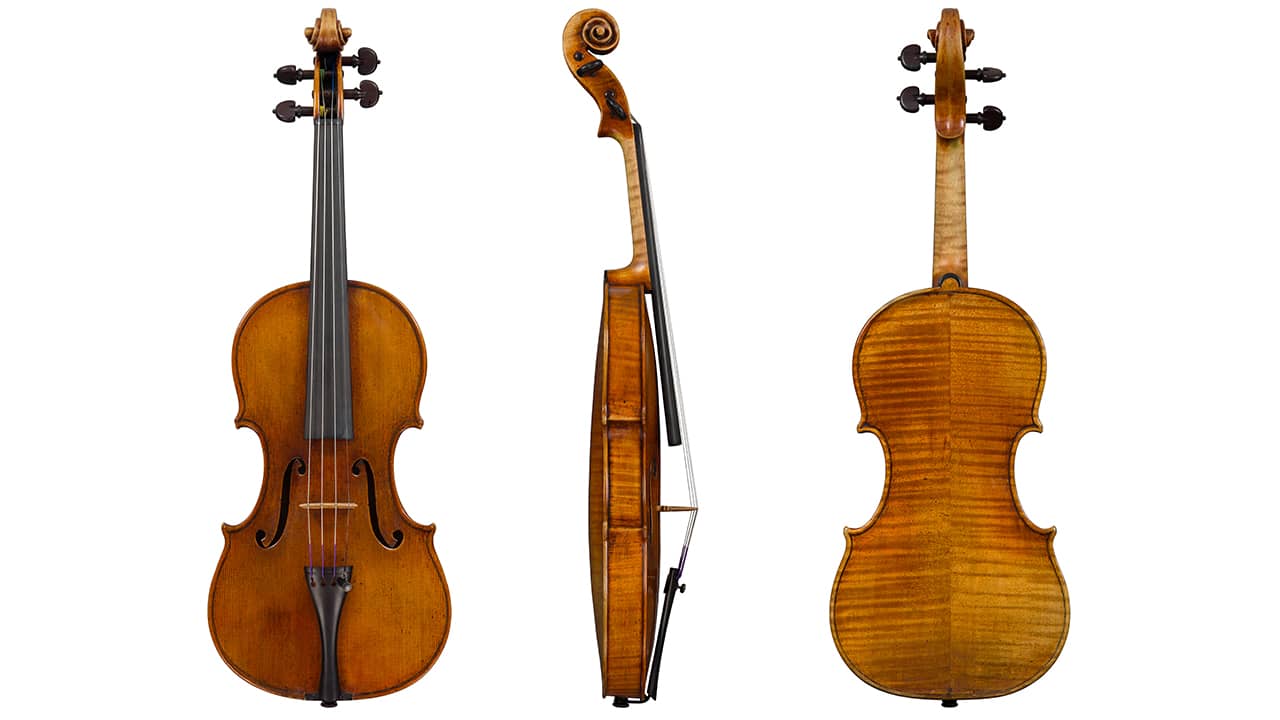
The 1741 "Playfair" Guarneri "del Gesù" violin.
Of course, I love Strads. I've played on many Strads, and many of them incredible," Ushikubo said. "But if you give too much on a Strad, it won't allow it. It needs a 'floatier' approach, it needs more subtlety and nuance."
"I think Strad players have a harder time playing a del Gesù, and del Gesù players have a harder time playing Strad," he said. "Del Gesu needs power. That's how I feel it, from my experience with these instruments, I think there's so many of them that I've not tried.
"I've been playing on this instrument now for almost two months, and I discover new sounds every day," Ushikubo said. "It's all about experimenting: figuring out in my head what I want, and trying to translate it physically onto the violin. And the violin tells me, 'Well, no, not really,' or 'Yes, that's great, the violin is actually capable, even more of that...'"
"So it's always constantly discussing with the violin, and occasionally arguing!" he said. "But it's all about communicating and building a better and more beautiful relationship."
You might also like:
- Help Needed: How to Launch a Career in Music
- Review: Los Angeles Chamber Orchestra Honors Stradivari Violins with Strad Fest LA
- Video Interview with Violinist Augustin Hadelich, Part 2: About 'del Gesù'
* * *
Enjoying Violinist.com? Click here to sign up for our free, bi-weekly email newsletter. And if you've already signed up, please invite your friends! Thank you.
Replies


He didn’t play it. It was nicknamed the Terminator because the extent of its power allows it to cut through and be heard above modern orchestras. A hugely powerful instrument.

Remarkable story, and masterful playing. Thank you for posting the recording of his December 3 recital. What a joy to learn the back story and to watch and listen to his performance.
This article has been archived and is no longer accepting comments.







December 12, 2025 at 11:42 PM · I was curious about the name, and it turns out the violin was owned by one Ms. Elsie Playfair, an Australian violinist. It's curious the names these fiddles get.
I also saw there is a "Terminator" Del Gesu, which sounds awesome, and I must only assume got its name from being played by Arnold Schwarzenegger plays in that movie "Stay Hungry". That's the violin I want to play most; it's probably seen some things!