
We have thousands of human-written stories, discussions, interviews and reviews from today through the past 20+ years. Find them here:


The Music Guild Remembers Dr. Sloan at Trio Azura Concert
I can only imagine Dr. Sloan's reaction, after a beautiful concert by Trio Azura on December 1 at St. Alban's Episcopal Church by UCLA, sponsored by The Music Guild.
He'd be tugging at my sleeve after the concert, smiling ear-to-ear, with that characteristic twinkle in his eye, "Did you hear that? They were phenomenal! Can you believe these young musicians? They can do anything!"
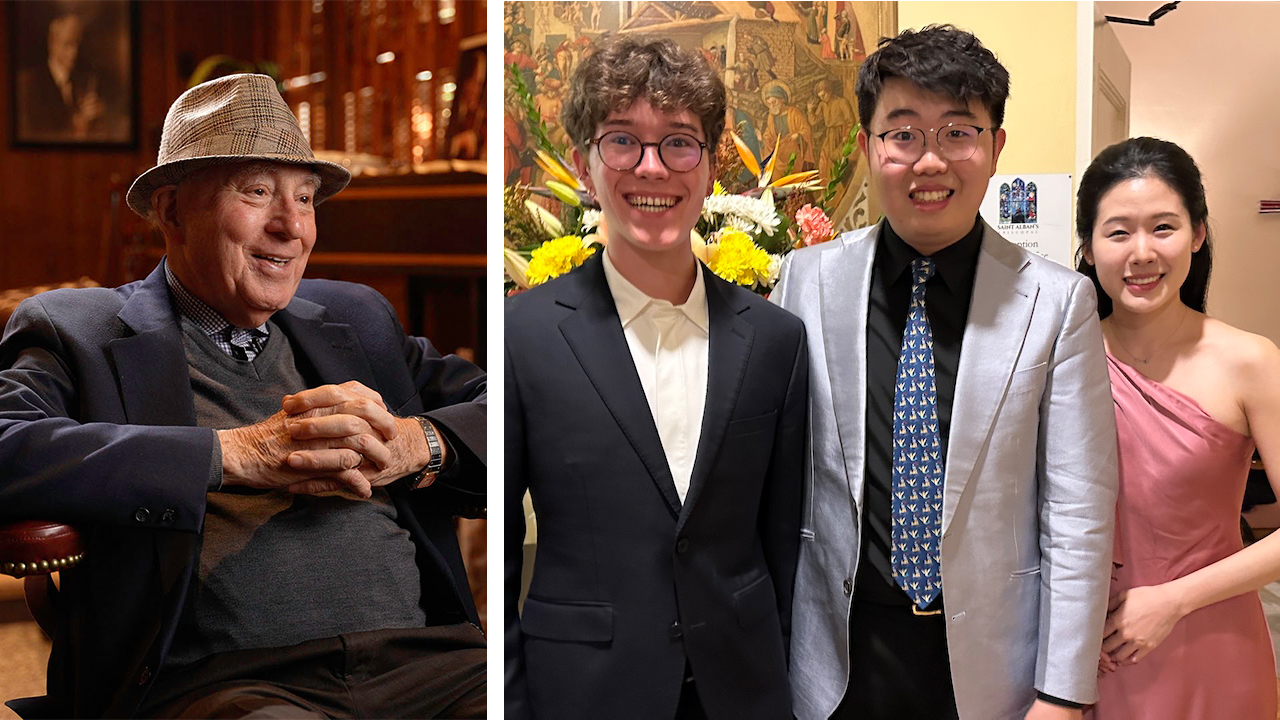
Left, the last Dr. William Sloan; right, Trio Azura on Dec. 1: Duncan McDougall, Tony Bai and Yejin Hong.
Dr. William Sloan - surgeon, amateur violinist, luthier, owner of two storied violins (the 1714 "Jackson" Stradivari and the 1742 "Sloan" Guarneri del Gesù) and great lover of everything violin - passed away in October at the age of 84, after a long illness. The Music Guild dedicated Monday's concert to Dr. Sloan, saying some words about him before the performance and featuring a lovely tribute to him in their program booklet.
Dr. Sloan was a longtime board member of The Music Guild, serving as its treasurer for some 20 years, and he scarcely ever missed a concert, until he fell too ill to go.
I had never been to a Music Guild concert, but you could say that Dr. Sloan brought me to this one - I knew it was being held in his memory and I did not want to miss that. And now I understand why he enjoyed these concerts so much.
This one featured Trio Azura: violinist Duncan McDougall, cellist Yejin Hong and pianist Yanfeng (Tony) Bai. The group is currently the Ensemble-in-Residence at the Colburn School, which is where they were founded in 2022. They have some impressive achievements under their belt, including winning the Grand Prize and Gold Medal at the 2024 Fischoff National Chamber Music Competition and won the Young Concert Artists Competition in 2025.
Here is a group in ascendancy - and in prime shape. They play with an acute sense of one another and of the music's ever-changing requirements. No one is the clear "hot dog" player - and yet no one isn't, either. Each can clearly step into the virtuoso seat when needed, or step back into a supporting role.
Starting the program with Haydn's Piano Trio No. 45 in E flat major, I could immediately see that this group has a great deal of spark and facility. I also noticed the genuinely appreciative Music Guild audience, which held its applause until the end, and then punctuated the clapping with a good deal of enthusiastic murmuring, "Just amazing, wow."
Ravel's Piano Trio in A minor brought out a different facet of this group, showing off the well-calibrated vibrato of both string players, and how well they could coordinate their sound with one another. And sometimes they used little vibrato at all; the cello and violin in unison several octaves apart as the piano rumbled beneath. So many textures! There was tenderness, insistence, dance, sparkle - amazing indeed, what just three musicians can create.
Intensity was the word for Mendelssohn's Piano Trio No. 2 in C minor, Op. 66. The Scherzo was so fast - I thought of watching someone race down a wicked-bad ski slope: "You are going way too fast on that black-diamond run!" Then they landed every jump and negotiated very turn and mogul without a sweat. Rather thrilling!
After the concert, I was one of many in the audience who greeted these three musicians to congratulate them on their fine playing.
I couldn't help but remember how Dr. Sloan often would track down performing musicians after performances, to say hello and perhaps have a look at their instruments. Not everyone could get away with this rather bold move, but he always did it with such a a spirit of admiration and generosity - it was clear he just loved the music, the artists, the performances, the whole thing.
When we attend a performance, of course we focus on the performers. But so much goes into supporting those performers - sparking their initial inspiration, ensuring their education, procuring their instruments. And so much goes into supporting the professional musicians in our communities - securing a venue for them to play, funding their performances, and last but certainly not least: cultivating a devoted audience that shows up to witness and celebrate this live art.
I think about all Dr. Sloan did to support music and musicians - loaning out instruments, serving on boards, holding recitals at his home, promoting young talent, showing up at every violin-related event he could find.
The best way to honor that legacy is to ask, "What can I do?" And then: Be bold about doing it!
You might also like:
- Remembering Dr. William Sloan (1941-2025)
- Colburn's Trio Azura Wins 2024 Fischoff Chamber Music Competition
- Testing the Sloan Strad and del Gesù Violins with Hao Zhou and Lucy Wang
* * *
Enjoying Violinist.com? Click here to sign up for our free, bi-weekly email newsletter. And if you've already signed up, please invite your friends! Thank you.
Replies
This article has been archived and is no longer accepting comments.







December 9, 2025 at 01:39 PM · What a wonderful person! He leaves a great legacy.