
We have thousands of human-written stories, discussions, interviews and reviews from today through the past 20+ years. Find them here:


The Week in Reviews, Op. 299: Maxim Vengerov; Stefan Jackiw; Daniel Lozakovich
In an effort to promote the coverage of live violin performance, Violinist.com each week presents links to reviews of notable concerts and recitals around the world.
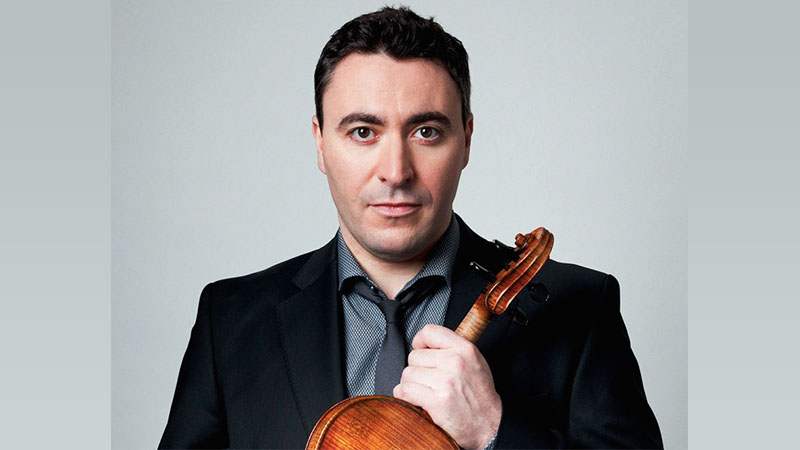
Violinist Maxim Vengerov.
Maxim Vengerov performed Bruch's Violin Concerto No. 1 with the Dallas Symphony Orchestra.
- Dallas Morning News: "Vengerov seemed to channel the finest features of Russian violin playing dating back to the great David Oistrakh (1908-1974). He could draw a huge but finely focused and polished sound from his ex-Kreutzer Stradivarius, but also the sweetest and most delicate pianissimos. He dispatched virtuoso passages with seemingly effortless élan but shaped lyric music with a fine singer’s sensitivity."
- Theater Jones: "On Thursday evening, Vengerov delivered. That first phrase, which climbs more than two and a half octaves to its end, is marked in the score with the slightest decrescendo, but Vengerov allowed the phrase to die away to nothing. Perfection."
Stefan Jackiw performed the Mendelssohn Violin Concerto in E minor with the Boston Philharmonic Youth Orchestra.
- Boston Globe: "...there was nothing routine or canned about Jackiw’s fiercely alert music-making on Sunday. Every phrase had its own distinctive shaping. Forward-leaning tempos in the outer movements conveyed a rhapsodic intensity."
- Boston Musical Intelligencer: "Jackiw’s immersion in historically informed performance style (yes this goes on in Mendelssohn) enlivened the warhorse concerto with much unexpected variety and interest. Instead of long lush melodic lines from the violin we heard shorter phrases given out with little vibrato and tapering off at the ends, their individual characters emphasized, and rhythmic motifs conveyed as gestures and not necessarily precisely in rhythm. Jackiw somehow made this approach sound utterly natural and un-studied."
Daniel Lozakovich performed the Tchaikovsky Violin Concerto with the Boston Symphony Orchestra.
- The Boston Globe: "On Thursday (the Tchaikovsky) was given a vividly dispatched, technically adroit rendition by the 18-year-old, Swedish-born violinist Daniel Lozakovich. He is clearly a gifted player with a bright future, and he won a cheering ovation on Thursday night."
Gil Shaham performed Bartók’s Violin Concerto No. 2 with the St. Louis Symphony Orchestra in Urbana, Ill.
- Smile Politely: "... the orchestra’s rendition of Bartók’s Violin Concerto No. 2 exploded with anxiety and dynamism. Led by Gil Shaham’s resolutely physical solo violin, the Bartók piece rearranged the mood of the evening considerably."
Eric Gratz performed Kurt Weill’s Concerto for Violin and Wind Orchestra with the San Antonio Symphony.
- MySanAntonio: "The Weill, from 1925, is a sophisticated, complex work. The music took severe angles and sounded on edge, as if walking dangerously close to a cliff. But Gratz was in complete control, playing with the purest of tones."
Viktoria Mullova performed Bach's A minor Violin Concerto with the Academy of Ancient Music.
- The Times: "Once a star of big concert halls playing the big romantic concertos, in recent years Mullova has recast herself as an intense, if emotionally austere, baroque specialist. She still stands out from the players of the AAM like a cheetah in a field of gazelle."
Glenn Dicterow and Eiko Kano performed Bach’s Concerto in D minor for Two Violins with Pegasus: The Orchestra.
- New York Classical Review: "(Conductor) Hakobyan led a bracing, rhythmically alive rendering of the opening Vivace, with Dicterow giving a master class in poised execution and natural phrasing that fellow soloist Kano and the other players did their best to match."
Midori Seiler performed Haydn's Violin Concerto No 1 with the Australian Haydn Ensemble.
- Limelight: "Against robust strings, Seiler revealed a singing high register and biting low, delivering elegantly shaped phrases and assured virtuosity. She brought a pure sound, with plenty of heat at its core, to the soulful melodies of the Adagio, over the orchestra’s pizzicati – not to mention a spacious, thoughtful cadenza – before dispatching a sparkling finale."
Please support music in your community by attending a concert or recital whenever you can!
TweetReplies


Should a period-performance attempt at something from the Mannerist period be a collage of mannerisms?
I'm more annoyed that Daniel Lozakovich keeps getting the "well this person is really too young and why are we obsessed with prodigies?" treatment. I saw him play five years ago, when he really was a child, and was incredibly impressed. At age 18, he is a young adult. With all the experience he has and with the very real musical maturity he has, I think he has the right to be reviewed as a legitimate artist, which he most certainly is. After all, violinists very often begin learning this instrument at age three; 15 years is plenty of time.

I agree about Daniel Lozakovich. I am sure there are still videos of his early playing floating around youtube that bear witness to his innate musicality even at an early stage (he started at age six). With his 2018 debut album (Bach) he presented himself as an impressive, mature artist with his own voice and should be reviewd as such.
So then - 12 years - still plenty of time to grow into an artist, especially for someone with that kind of dedication and gift.
This article has been archived and is no longer accepting comments.








November 27, 2019 at 04:30 PM · I went to see Angelo Xiang Yu perform the Tchaikovsky Violin Concerto on Friday with the Colorado Symphony.
I was curious about seeing him again after seeing him a season or two ago, playing the Vivaldi Four Seasons, where he seemed to very heavily emphasize the effects of the piece (and presumably the programmatic poems tied to each season) at the expense of a more abstract and coherent musical statement. It struck me as a valid post-modern sort of reading of the piece, but it made me wonder about hearing him in other repertoire that I feel is closer to absolute music.
Suprisingly, he took very much the same approach in the Tchaikovsky, where, instead of spinning long lines out, his phrasing was pretty curt, and his dynamics and scattershot use of vibrato didn't build anything that lasted more than a few seconds. He tended to play bits of cantilena very beautifully, but any multiple stopping was played usually without vibrato and with a pretty sharp attack. Often he would descend to such a wispy piano so as to be striking as an effect, but pretty unconnected to everything before and after. Basically it was a series of effects that ended up being a collage of mannerisms that didn't add up to any larger meaning.
To his credit, he never forced the tone, and the individual bits were interesting, but before the end of the first movement, I was just thinking, "What's he going to do next?". He got a huge standing ovation from the audience. I saw him work very well in a chamber music setting a month ago, but I'm not sure if I'll bother again - Maybe if I think the repertoire can survive such an approach.